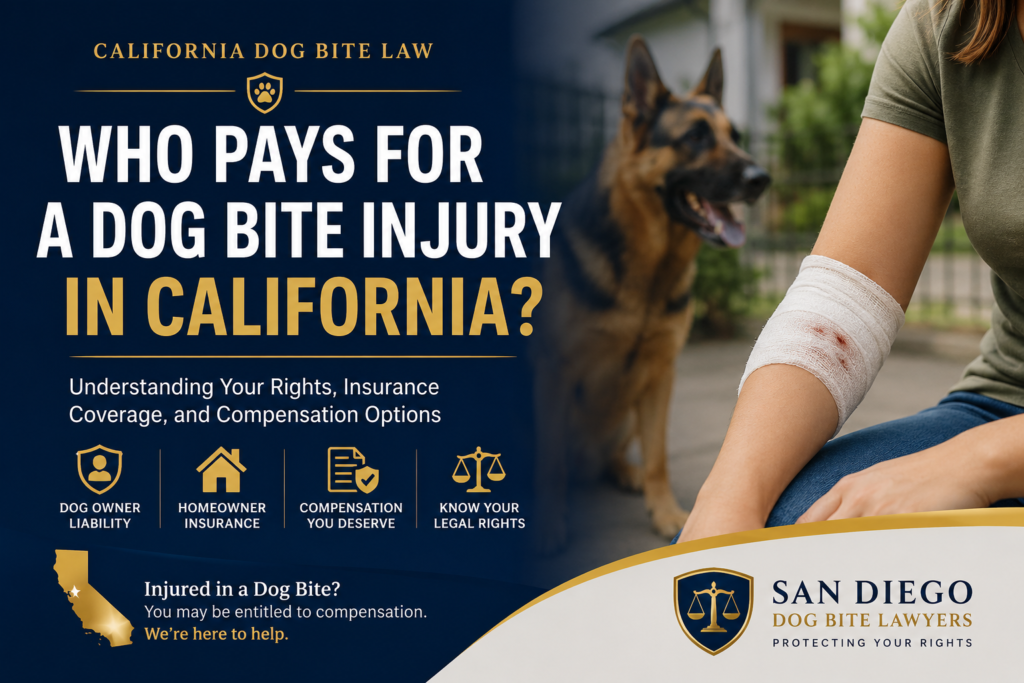
Who pays for a dog bite injury in California? After a dog bite in California, one of the first practical questions that runs through every victim’s mind is not about legal strategy or litigation timelines — it is simply this: who is actually going to pay for this? Who covers the emergency room bill, the specialist visits, the time you missed at work, the scar on your arm that is not going away?
The answer is more layered than most victims expect, and understanding it early can significantly affect both the amount you recover and how smoothly the process unfolds. If you have already read our previous guide on what happens after a dog bite in California, you know that California law places automatic liability on dog owners under Civil Code Section 3342. This article takes that foundation and answers the next logical question: once liability is established, where does the money actually come from?
The Primary Source — Homeowner’s Insurance
In the vast majority of California dog bite cases, compensation is paid through the dog owner’s homeowner’s insurance policy. This is not a loophole or a workaround — it is the exact purpose of the personal liability section that exists in virtually every standard homeowner’s policy in California.
Personal liability coverage is included in homeowner’s insurance to protect the policyholder against claims arising from injuries that occur on their property or as a result of their household — including their pets. A dog bite that causes injury, whether it happened in the owner’s backyard, on a public sidewalk, or at a park, typically falls squarely within the scope of that coverage.
Standard homeowner’s policies in California carry personal liability limits ranging from $100,000 to $300,000, though many policies carry higher limits. When a dog bite claim is filed, the insurer assigns an adjuster to investigate and manage the claim. That adjuster’s job — it is important to understand this clearly — is to resolve the claim for as little as possible. They are skilled professionals, and they will look for every reasonable angle to limit what the company pays.
This is precisely why having an experienced dog attack injury attorney involved from the beginning matters. Victims who negotiate directly with homeowner’s insurance adjusters routinely accept settlements that cover their immediate medical bills while leaving significant future costs, pain and suffering damages, and income losses entirely on the table.
What Homeowner’s Insurance Typically Covers in a Dog Bite Claim
When a homeowner’s insurance policy responds to a dog bite claim in California, it can cover a broad range of damages, including emergency medical treatment, ongoing wound care and follow-up appointments, surgical costs and reconstructive procedures, prescription medications, lost wages during recovery, and compensation for pain, suffering, emotional distress, and permanent scarring. The specific amount recoverable depends on the severity of your injuries, the policy limits in place, and how thoroughly your damages are documented and presented.
One thing many victims do not realize: some homeowner’s policies contain breed exclusions for certain dogs — commonly pit bulls, Rottweilers, and German Shepherds among others. If a breed exclusion applies to the dog that bit you, the insurer may deny coverage under the homeowner’s policy. This is not the end of the road, but it does mean looking at other sources of recovery, which experienced attorneys are well-equipped to identify.
Renter’s Insurance — The Coverage Most Tenants Do Not Think About
Many people associate dog bite insurance coverage exclusively with homeownership, but renter’s insurance policies carry the same personal liability coverage as homeowner’s policies — and the same protections apply. If the dog that bit you belonged to a tenant rather than a property owner, their renter’s insurance is typically the primary source of compensation.
Renter’s insurance policies are generally more affordable than homeowner’s policies and may carry somewhat lower liability limits, but standard coverage of $100,000 or more is common. In San Diego County, where a substantial portion of the population rents — particularly in areas like Downtown San Diego, Chula Vista, and El Cajon — renter’s insurance is often the first and most accessible source of recovery for dog bite victims.
The same adjuster dynamics apply with renter’s insurance as with homeowner’s coverage. The insurer’s goal is to limit payout. An attorney’s role is to ensure the full picture of your damages is documented, presented, and negotiated for with appropriate force.
Umbrella Policies — The Coverage That Can Change Everything
Beyond base homeowner’s or renter’s policies, many California property owners carry personal umbrella liability policies that extend their coverage well above the underlying policy limits. Umbrella policies typically provide an additional $1 million to $5 million in liability coverage that kicks in once the base policy limits are exhausted.
In cases involving severe injuries — significant scarring, nerve damage, surgeries, long recovery periods, or permanent disability — the damages can exceed what a standard homeowner’s policy covers. In those situations, the existence of an umbrella policy can be the difference between a victim recovering their full losses and accepting a partial settlement because the base policy ran out.
Insurance companies are not obligated to volunteer the existence of umbrella policies during the claims process. One of the concrete advantages of working with a dog bite claim attorney in San Diego is that experienced lawyers specifically investigate for umbrella coverage as a standard part of case preparation.
Landlord and Property Owner Liability
When a dog bite occurs at a rental property, the liability picture sometimes extends beyond the individual dog owner. California premises liability law creates a duty for property owners — including landlords and property management companies — to maintain reasonably safe conditions for tenants, guests, and visitors on their property.
If a landlord or property manager knew that a tenant kept a dangerous dog on the premises and failed to take reasonable action — requiring the dog to be removed, restricting access to common areas, posting warnings, or enforcing lease terms that prohibited dangerous animals — that landlord may share liability for any resulting injuries.
This is a significant avenue of recovery that many victims never pursue. Landlords, property management companies, and real estate investment entities often carry commercial general liability policies with substantially higher limits than individual renter’s insurance. In an apartment complex dog bite case where the property manager had received prior written complaints about the dog and done nothing, the potential recovery from the commercial policy can far exceed what the renter’s policy alone would provide.
Establishing landlord liability requires specific evidence — written complaints, lease terms, management records, and communication history that documents the property owner’s knowledge of the risk. Gathering this evidence is time-sensitive. An attorney should be involved as early as possible when a rental property is involved in a dog bite incident.
Commercial Property and Business Liability
San Diego has no shortage of dog-friendly businesses — breweries, outdoor cafes, pet supply retailers, and other establishments that actively welcome animals. When a business allows dogs on its premises, it assumes a duty of care toward its customers and employees. If a dog bites a customer or worker at a California business and the business failed to establish or enforce reasonable pet safety measures, that business can face liability through its commercial general liability insurance.
Commercial policies typically carry much higher coverage limits than personal insurance, making business premises dog bite claims particularly valuable when the facts support them. These cases often require a careful analysis of the business’s written policies, employee training, incident history, and how the business responded to the dog’s behavior before the attack occurred.
What Happens When the Dog Owner Has No Insurance?
Uninsured dog owners are an unfortunate reality. Some homeowners and renters simply do not carry adequate insurance coverage, or their policy excludes the dog involved in the attack. This situation is more complex, but it does not necessarily mean a victim is without options.
The first question is whether any other liable party exists — a landlord, a property manager, a business, or any third party whose negligence contributed to the attack. These secondary avenues of liability often carry their own insurance and can provide meaningful recovery even when the dog owner’s personal coverage is absent or insufficient.
The second option is pursuing the dog owner’s personal assets directly through a civil judgment. This is a more labor-intensive route, and its viability depends on what assets the dog owner actually holds. An attorney experienced in California dog bite litigation can assess the realistic value of this approach and advise honestly on whether it makes sense given the specific circumstances of the case.
The Dog Bite Settlement Process in California
Once an attorney is managing your claim, the process of reaching a dog bite settlement in California follows a reasonably predictable path. Your attorney compiles a comprehensive demand package — including all medical records and bills, evidence of lost income, photographic documentation of your injuries, and a written narrative connecting the legal liability to your documented damages. That package is submitted to the responsible insurer with a specific demand figure.
The insurer evaluates the package and responds, typically with a counter-offer below the demand. Negotiations proceed through multiple exchanges until the parties reach an agreement or determine that litigation is required. Most dog bite cases in California resolve through settlement. A smaller percentage proceed to formal litigation, and fewer still reach trial — but having an attorney who is genuinely prepared to litigate is what motivates insurers to settle fairly rather than stall indefinitely.
One critical piece of advice that applies at every stage of this process: do not accept any settlement offer without first having an attorney review it in the context of your full documented damages, including future medical costs. Insurers frequently make early offers that cover past medical bills but ignore future treatment needs, ongoing psychological therapy, income loss projections, and the full value of pain, suffering, and permanent disfigurement. Once you sign a release, the claim is permanently closed. There are no second chances.
Common Mistakes California Dog Bite Victims Make That Reduce Their Compensation
Giving a Recorded Statement Too Early
The first call from an insurance adjuster after a dog bite is not a courtesy check — it is a claims management move. Adjusters are trained to ask questions that can be used to minimize liability or assign comparative fault. Statements made before an attorney is involved, before the full medical picture is clear, and before you understand the value of your claim are routinely used to justify lower offers. Decline any request for a recorded statement until you have legal representation in place.
Settling Before Medical Treatment Is Complete
Insurance companies sometimes extend early settlement offers that seem reasonable given what you know about your injuries at the time. The problem is that dog bite injuries often have consequences that are not fully apparent in the first weeks after an attack — nerve damage, infection complications, PTSD, and scarring that requires additional procedures. Settling before reaching maximum medical improvement means permanently forfeiting the right to recover those future costs.
Failing to Report the Bite to Animal Control
The animal control report creates an official government record of the incident and may reveal prior bite history that is directly relevant to the value of your claim. Skipping this step eliminates evidence that cannot be reconstructed later.
Assuming One Policy Is All That Exists
Victims who contact the dog owner’s insurer directly often accept whatever that single policy offers without investigating whether additional coverage exists — umbrella policies, landlord coverage, commercial liability policies. An attorney’s investigation of all available coverage is one of the most concrete ways legal representation increases total recovery.
Waiting Too Long to Contact an Attorney
California’s two-year statute of limitations for personal injury claims can create a false sense of time. In practice, the quality of evidence degrades rapidly — surveillance footage is overwritten, witnesses relocate, and animal control records become harder to access. Cases built on evidence gathered promptly are consistently stronger than cases assembled months or years after the fact.
Frequently Asked Questions — Who Pays for Dog Bite Injuries in California
Does the dog owner personally pay me after a dog bite?
In most California dog bite cases, the dog owner’s homeowner’s or renter’s insurance company pays the claim — not the owner directly out of pocket. Personal liability coverage exists specifically for this purpose. Filing a claim against that coverage is not a financial attack on the individual; it is using an insurance system the owner pays premiums into precisely for situations like yours.
What if the dog owner’s insurance denies the claim?
Insurance companies deny or dispute claims for various reasons — breed exclusions, allegations that you provoked the dog, or arguments that you were not lawfully on the property. These denials can be challenged. An attorney can review the denial, assess whether it has legal merit, and pursue the claim through negotiation or litigation if the denial is improper. A denial letter is not the final word.
Can I recover compensation if the dog bite left a scar?
Yes. Permanent scarring — particularly facial scarring or scarring on visible areas of the body — is recognized under California law as a distinct and significant category of non-economic damages. The compensation value for scarring accounts for the permanent physical mark itself, its psychological and emotional impact, any future cosmetic or reconstructive procedures it may require, and the effect on the victim’s professional and social life.
What if the bite happened at an apartment complex in San Diego?
Dog bites at apartment complexes may support claims against both the tenant who owns the dog and the property management company or landlord if they had prior knowledge of the dangerous animal. Many apartment complexes carry commercial general liability policies with higher coverage limits than individual renter’s insurance. Our attorneys regularly identify and pursue this dual-track recovery for victims bitten in San Diego’s apartment communities.
How long does a dog bite settlement typically take in California?
Settlement timelines vary based on injury severity, the cooperation of the insurer, and whether litigation becomes necessary. Straightforward claims with clear liability and contained injuries may resolve in three to six months. Cases involving serious injuries, multiple defendants, or disputed liability often take twelve months or more. Cases that proceed to trial extend the timeline further. An attorney can give you a realistic assessment based on the specific facts of your case.
You Deserve to Know the Full Value of Your Claim Before You Accept Anything
The insurance process after a California dog bite is not designed with your maximum recovery in mind. It is designed to close claims efficiently and cost-effectively — for the insurer. Understanding who actually pays, what coverage exists, and what your full damages are worth is the foundation of every successful outcome.
If a dog bit you anywhere in San Diego County — whether you are dealing with a homeowner’s insurer, a renter’s policy, or a more complex situation involving a landlord or business — a free case evaluation from our attorneys costs you nothing and gives you the information you need to make an informed decision. Our team serves the full San Diego region, and we handle every case on a contingency basis — no fees unless we recover compensation for you.
For more information about the California dog bite legal process and your rights as a victim, visit dogbitelawyersandiego.com or explore our full library of legal resources at blog.dogbitelawyersandiego.com. The right information at the right time is the most powerful tool you have in protecting your claim.