One of the most common and most reasonable questions California dog bite victims ask after the immediate medical crisis has passed is: how long does a dog bite settlement take? The honest answer — the kind an experienced attorney gives rather than a marketing-friendly one — is that it depends on factors specific to your case, and understanding those factors is what allows you to set realistic expectations while protecting the full value of what you are owed.
This article covers the complete California dog bite settlement timeline: the phases every claim moves through, the factors that determine whether your case resolves in months or years, the reasons claims get delayed, and what you should be doing while the process unfolds. It is part of our ongoing California dog bite legal series that covers everything from immediate steps after an attack through the evidence that drives claim value. If you have followed this series from the beginning, this article brings the settlement process into focus as the practical conclusion of everything that comes before it.
How Long Does a Dog Bite Settlement Take in California — The Direct Answer
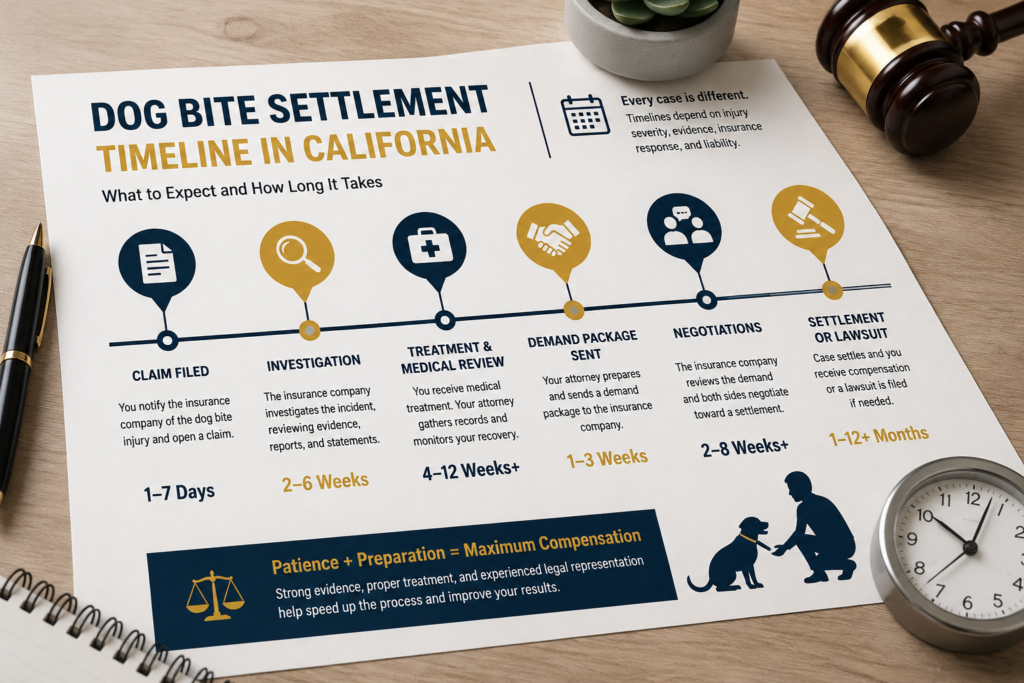
California dog bite cases settle across a wide range of timelines. Straightforward cases — clear liability, contained injuries that have fully resolved, a responsive insurer, and well-documented damages — can reach settlement in three to six months from the date of the attack. Moderate cases involving more significant injuries, some complexity in the liability picture, or an insurer that requires additional negotiation commonly take six to twelve months. Serious injury cases, cases that require formal litigation, and cases involving multiple defendants routinely extend beyond twelve months and in some instances take two years or more to fully resolve.
The most important variable in that range is not how quickly you want the case to resolve — it is how long your medical treatment takes to reach completion. Settling before your injuries are fully treated, and before your future medical costs are properly documented, is one of the most financially damaging mistakes a California dog bite victim can make. Speed and value are sometimes in direct tension, and understanding where that tension exists is essential to managing your case intelligently.
Phase One — Medical Treatment and Evidence Building
The settlement process does not meaningfully begin until the medical process has reached what treating physicians call maximum medical improvement — the point at which your condition has stabilized, your immediate treatment needs are addressed, and your future care requirements can be projected with reasonable clinical accuracy. Settling before this point means accepting a figure based on incomplete damages, and no release signed at settlement can be undone to account for complications or costs that emerge later.
This phase is also when the evidentiary foundation of your claim is built. As our detailed guide on what evidence you need for a California dog bite claim explains, the quality of your documentation directly determines what your claim can support in negotiations. Medical records, photographic documentation of injuries throughout the healing process, animal control reports, witness statements, and income records all need to be in order before a demand package is prepared.
For minor injuries that fully resolve within a few weeks — clean bites requiring only emergency treatment and a short course of antibiotics, no permanent effects — this phase is short and the overall timeline compresses accordingly. For injuries involving surgery, infection complications, nerve damage, significant scarring, or psychological trauma, this phase takes longer, and the timeline extends to reflect the reality of what recovery actually requires.
Cases involving severe dog attack injuries — facial reconstruction, orthopedic procedures, long-term physical therapy, psychiatric care — may require the longest medical treatment phase of any California dog bite case category. Attempting to shortcut that phase to accelerate settlement is the single choice most likely to leave substantial money permanently on the table.
Phase Two — The Demand Package and Insurance Investigation
Once maximum medical improvement is reached and all damages are documented, your attorney prepares and submits a formal demand package to the responsible insurer. This document presents the legal basis for liability under California Civil Code Section 3342, the complete medical documentation including future care projections, income loss calculations, and a well-supported demand figure reflecting the full value of economic and non-economic damages.
The insurer then conducts its own investigation and evaluation of the claim. This phase typically takes 30 to 60 days, though some insurers respond more quickly and others take longer depending on the complexity of the claim, the adjuster’s caseload, and whether the insurer is requesting additional documentation or independent medical evaluations. During this period, the insurer is assessing both liability — which in a California strict liability case is rarely a genuine dispute — and damages, which is where their scrutiny is focused.
As discussed in our guide on how homeowners insurance covers dog bite claims, the adjuster’s professional objective is to resolve the claim at the lowest defensible figure. The demand package your attorney submits sets the ceiling and establishes the evidentiary foundation for everything that follows.
Phase Three — Settlement Negotiations
After the insurer completes its evaluation, they respond to the demand — almost invariably with a counter-offer below the amount demanded. This begins the negotiation phase, during which your attorney and the adjuster exchange positions, each supported by the evidence and legal arguments available to each side. This phase can involve two rounds of negotiation or ten, depending on how wide the gap is between positions and how motivated each side is to reach resolution.
The single most important factor in the negotiation phase — beyond the quality of the evidence — is whether the insurer believes your attorney is genuinely prepared to file a formal dog bite lawsuit in California if negotiations fail. Adjusters settle more fully, and more promptly, when they are confident that declining to make a fair offer will result in litigation with its associated costs, discovery obligations, and jury risk. Attorneys whose litigation record is credible consistently produce better negotiated outcomes than those whose threat of suit is perceived as empty.
For claims across San Diego County — whether in Downtown San Diego, Chula Vista, or El Cajon — the negotiation phase typically adds one to three months to the timeline in straightforward cases. More complex negotiations, or situations where the insurer has taken an unreasonable initial position, can extend this phase significantly.
When Litigation Extends the Timeline
Not every California dog bite case settles before a lawsuit is filed. When an insurer refuses to offer fair compensation, disputes liability on questionable grounds, or applies policy exclusions that an attorney concludes are improper, filing a formal lawsuit in California Superior Court becomes the appropriate next step.
Litigation does not mean a case will go to trial — the vast majority of litigated dog bite cases still settle before a jury hears them. But initiating formal legal proceedings does extend the timeline and restructure the process. Once a lawsuit is filed, the case enters the discovery phase: both sides exchange written questions and document requests, conduct depositions of parties and witnesses, and retain expert witnesses to address complex damages questions. This phase typically takes six to twelve months depending on court scheduling, the volume of discovery involved, and whether any discovery disputes arise.
After discovery, many cases settle — often at values significantly higher than what the insurer offered before litigation began, because the discovery process has produced additional evidence and the prospect of trial has become concrete rather than theoretical. Cases that do not settle at this stage proceed through mediation, pretrial motions, and ultimately trial. The complete timeline from lawsuit filing to trial verdict in San Diego County, depending on court scheduling and case complexity, can range from one to two years.
For child dog bite cases, an additional procedural step applies: any settlement on behalf of a minor must be approved by a California court through a petition process, which adds time to the final resolution even when the parties have already reached agreement on settlement terms. This is a legal protection for minor victims, ensuring that settlements adequately account for the long-term impact of their injuries before being finalized.
Factors That Delay California Dog Bite Settlements
Disputed Liability or Coverage
While California’s strict liability standard makes liability disputes less common in dog bite cases than in other personal injury matters, they do occur — particularly when the dog owner or their insurer argues comparative fault, provocation, or trespass. Breed exclusions and other coverage disputes under homeowners policies also create delays while the coverage question is resolved separately from the underlying liability question. Each contested issue adds time to the overall timeline.
Multiple Defendants
Cases involving both a dog owner and a third party — a landlord who knew about a dangerous tenant dog, a property management company, or a business whose negligent pet policy contributed to the attack — involve coordinating claims against multiple defendants and their respective insurers. These premises liability dog bite cases are often higher in value, but the coordination involved adds procedural complexity and time. As our guide on who pays for dog bite injuries in California explains, the existence of multiple coverage sources can significantly increase total recovery — but the process of identifying and coordinating those sources takes time that single-defendant cases do not require.
Insurance Company Delay Tactics
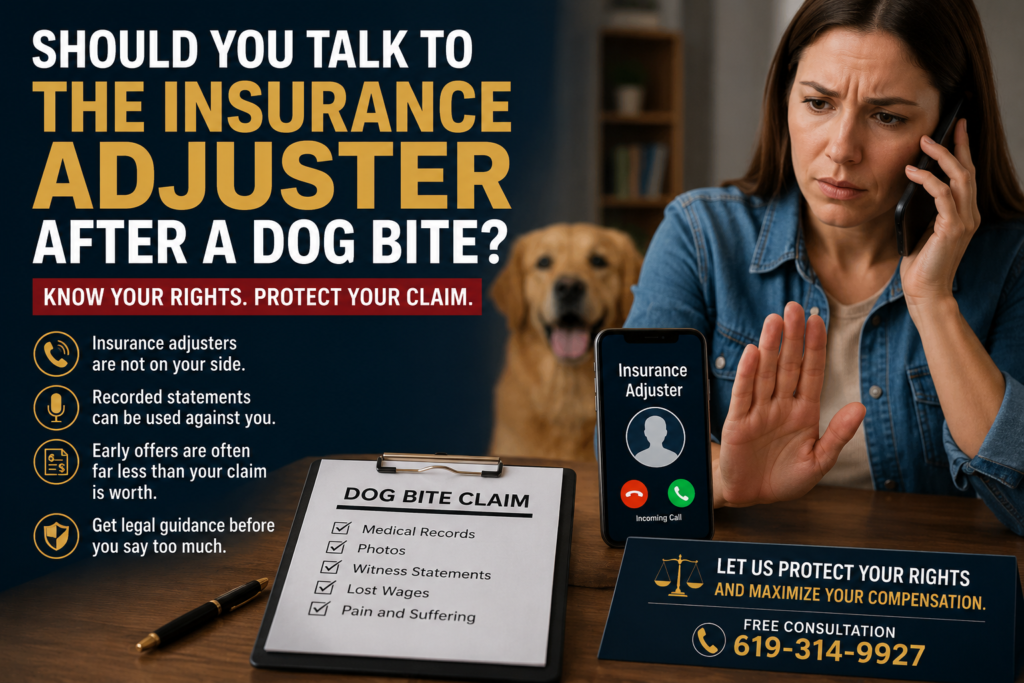
Experienced California dog bite attorneys recognize insurer delay tactics when they appear: repeated requests for documentation that has already been provided, assignment of the claim to a new adjuster mid-negotiation, requests for independent medical examinations designed to produce lower damage assessments, and prolonged periods of silence that stretch weeks beyond reasonable response timelines. These tactics are not always passive — sometimes they are deliberate strategies designed to pressure victims into accepting lower offers out of financial fatigue.
The practical counter to insurer delay is an attorney who maintains consistent, documented follow-up and who is visibly prepared to file suit when delays become unreasonable. An attorney’s credible litigation readiness is the most effective check on bad-faith delay behavior, and it is one of the concrete practical benefits of professional representation that unrepresented victims consistently lack.
Incomplete Medical Documentation
When victims settle before reaching maximum medical improvement, or when medical documentation has gaps — missed appointments, unexplained treatment interruptions, or failure to seek mental health treatment for documented psychological trauma — insurers use those gaps to justify lower offers and to extend negotiations while pushing back on the damages presented. Complete, uninterrupted medical documentation accelerates negotiations by removing the evidentiary basis for lowball positions.
Factors That Can Accelerate a California Dog Bite Settlement
Clear liability, well-documented injuries, responsive insurance coverage, and an attorney with a credible litigation reputation create the conditions most favorable to a faster settlement. Cases where liability is undisputed — where the dog owner’s insurer acknowledges responsibility without challenge — move through the demand and negotiation phases more quickly than contested cases. Cases with contained injuries that have fully resolved eliminate the waiting period associated with ongoing medical treatment.
Thorough preparation of the demand package also accelerates the process. A demand supported by comprehensive medical records, clear future cost projections, organized income loss documentation, and a well-reasoned legal narrative leaves the insurer with less to dispute and less reason to extend negotiations. The quality of dog bite claim preparation in San Diego directly affects how quickly insurers engage seriously with settlement discussions.
What You Should Be Doing While Your Case Is Pending
The period between retaining an attorney and receiving a settlement check is not passive time. Continuing and completing all recommended medical treatment is the most important thing a California dog bite victim can do during the claims process. Consistent treatment builds the medical record, ensures that future cost projections are clinically well-supported, and prevents the documentation gaps that insurers exploit.
Maintaining a personal injury journal throughout the recovery period — daily entries documenting pain, limitations, emotional state, and disruptions to daily life — continues to build the non-economic damages record that supports pain and suffering and loss of enjoyment of life claims. This first-person documentation is most valuable when it is maintained consistently over time, not reconstructed at the end of the process from memory.
Suspending social media activity for the duration of the claims process, as discussed in our evidence guide, protects against the routine practice of insurance companies monitoring claimants’ online presence for material that can be used to minimize damages. As straightforward as this precaution is, it is overlooked with surprising frequency and the consequences can be significant.
Finally, maintaining open communication with your attorney and responding promptly to requests for additional documentation or information keeps the case moving at the pace your attorney is working to maintain. Delays in receiving records or signed authorizations from clients create bottlenecks in an otherwise well-managed claims process.
Frequently Asked Questions — Dog Bite Settlement Timeline in California
Can I speed up my California dog bite settlement by accepting a lower offer?
You can always accept a lower offer to close the case faster — but doing so means permanently forfeiting the difference between what you accepted and what the claim was actually worth. As our guide on average dog bite settlement values explains, the non-economic damages component and future medical costs are frequently the largest elements of a serious injury claim, and they are the components that early, low offers most systematically exclude. Speed purchased by accepting inadequate compensation is not a strategic advantage — it is a permanent financial loss.
Does hiring an attorney make the settlement process take longer?
The evidence consistently indicates the opposite. Attorneys who prepare comprehensive demand packages, respond effectively to insurer delay tactics, and negotiate from positions backed by credible litigation readiness resolve cases more efficiently than unrepresented victims, who typically cycle through extended low-offer exchanges without the knowledge or leverage to break the impasse. Attorney involvement tends to accelerate meaningful progress while producing better outcomes.
What happens if the insurance company stops responding during negotiations?
Insurer non-response is a recognizable tactic that experienced California dog bite attorneys address directly — through documented follow-up communications, formal deadline notices, and when appropriate, by filing suit to end the delay dynamic entirely. The threat of imminent litigation is the most effective tool available when an insurer has decided that delay serves its interests better than engagement.
How long after a settlement is reached do I actually receive payment?
Once a settlement agreement is reached and a release is signed, California insurers typically issue payment within 30 to 45 days. Processing the release, confirming any liens — including medical provider liens and health insurer subrogation claims — and disbursing the net proceeds through your attorney’s trust account adds some time beyond the insurer’s payment timeline. Your attorney handles the lien resolution process, which ensures you receive the correct net amount after all valid claims against the settlement are addressed.
Does filing a lawsuit always mean the case will go to trial?
No. The majority of California dog bite lawsuits settle before trial, often during or after the discovery phase when the evidence picture is fully developed and both sides have a realistic assessment of trial risk. Filing suit is a procedural step that changes the dynamic of settlement negotiations and creates discovery obligations — it is not a commitment to trial. Experienced dog attack injury attorneys in California file suit when circumstances require it and continue pursuing settlement at the right value throughout the litigation process.
Realistic Expectations Lead to Better Outcomes
Understanding how long a dog bite settlement takes in California — and why — protects you from two equally damaging mistakes: accepting an early offer out of impatience, and becoming so frustrated by the process that you lose confidence in pursuing what you are owed. The timeline exists because building a well-supported, maximum-value claim takes time. The medical treatment phase is not delay — it is the foundation. The evidence-building phase is not bureaucracy — it is what your settlement negotiations stand on.
If a dog bit you anywhere in San Diego County and you want to understand specifically what the timeline looks like for your situation, a completely free case evaluation is available through our team at dogbitelawyersandiego.com. No upfront costs, no obligation, and no attorney fees unless we recover compensation for you. The complete California dog bite legal resource series is available at blog.dogbitelawyersandiego.com.