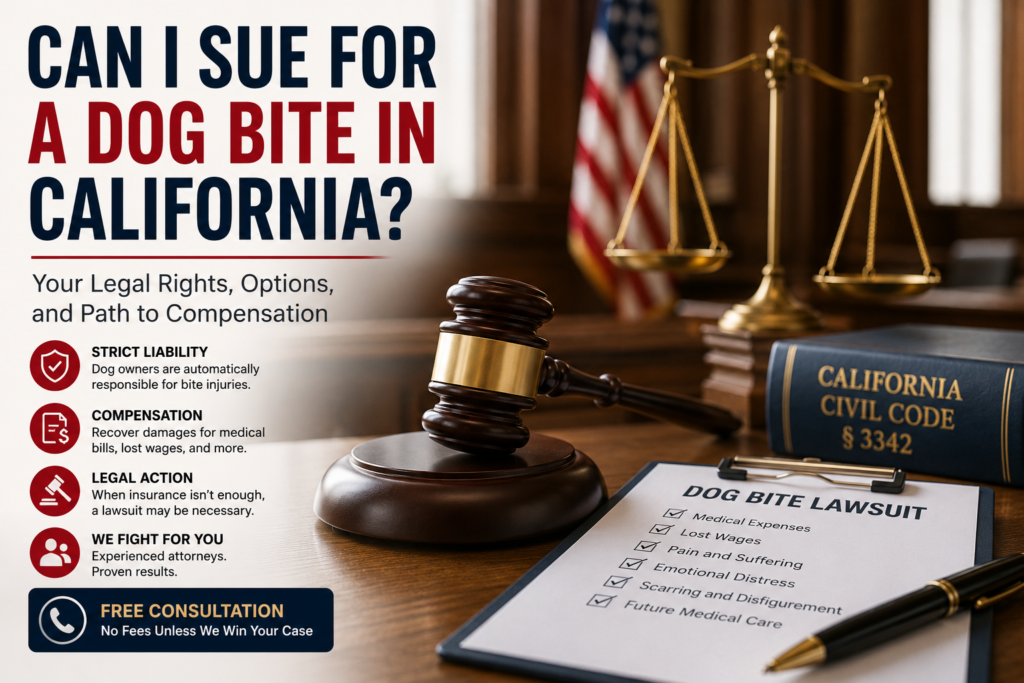
The common mistakes that can hurt a dog bite claim in California are not random errors — they are predictable patterns that insurance companies count on. Every year, California dog bite victims who have legally valid, well-founded claims walk away with significantly less compensation than they deserve, not because of weaknesses in California’s strict liability law, not because their injuries were not serious enough, but because of decisions made in the days, weeks, and months after the attack that quietly eroded their claim’s value before negotiations even began.
This article covers the mistakes that experienced California dog bite attorneys see most frequently — the decisions that insurance adjusters are trained to identify and exploit, and the errors that are entirely avoidable when victims understand what is at stake. This is part of our California dog bite legal series, which covers the complete claims process from immediate steps after an attack through how long settlements take in California. Understanding what not to do is as important as understanding the law itself.
The Most Common Mistakes That Can Hurt a Dog Bite Claim in California
Mistake One: Delaying or Skipping Medical Treatment
The single most damaging mistake a California dog bite victim can make is delaying medical treatment or deciding to “watch and see” whether a wound worsens before going to a doctor. Dog bite wounds are deceptive. A wound that appears manageable on the surface can harbor serious infection in the deeper tissue layers. Puncture injuries specifically create low-oxygen environments where bacteria thrive rapidly and invisibly.
From a legal standpoint, the damage of delayed treatment is equally serious. The emergency room or urgent care record created on the day of the attack is the first official documentation of your injuries and their cause. When that record is created days after the attack rather than hours, insurance adjusters immediately question how serious the injuries actually were. “If the bite was as severe as claimed, why did the victim wait three days to see a doctor?” is a question defense counsel will ask — and it is a question without a good answer when the delay was purely precautionary.
Get medical care on the same day the bite occurs. Every subsequent treatment record builds on that foundation. Skipping the foundation weakens everything built on top of it.
Mistake Two: Failing to Report the Bite to Animal Control
California requires dog bites to be reported, and that reporting requirement serves victims’ interests directly. The animal control report creates a government record of the incident that is independent of anything you or the dog owner says. It identifies the dog, its owner, the date, and the location. It may reveal prior bite complaints about the same animal — information that is directly relevant to the value of your claim even though California’s strict liability law does not require prior history to establish liability.
Victims who handle the aftermath informally — accepting the dog owner’s apologies and promises to cover medical bills without creating any official record — frequently find themselves without documentation when those promises evaporate. The dog owner’s cooperation at the scene does not substitute for an official report. Create the record regardless of how cooperative or remorseful the owner appears.
Mistake Three: Speaking With the Insurance Adjuster Without Legal Representation
Shortly after a dog bite, the dog owner’s homeowner’s or renter’s insurance company will contact the victim to request a recorded statement. The adjuster will introduce themselves professionally, express concern for the victim’s wellbeing, and frame the recorded statement as a routine part of processing the claim. What they will not explain is that the statement is specifically designed to produce information useful for limiting the company’s liability.
Insurance adjusters are trained professionals whose performance is evaluated on how effectively they resolve claims within budget. The questions they ask are constructed to elicit responses that can support comparative fault arguments, minimize injury descriptions, or characterize the dog’s behavior in ways that suggest provocation. A victim who describes being “startled” and “moving toward” the dog before the bite has provided material for a comparative fault argument that did not exist before the call.
No recorded statement should be given to any insurance company before an attorney is involved. This is not about being adversarial — it is about recognizing that the adjuster is a professional advocate for the insurer’s financial interests, and you deserve equivalent professional advocacy before making any permanent recorded statement about your claim.
Mistake Four: Accepting an Early Settlement Offer
Insurance companies extend early settlement offers for a straightforward reason: early offers precede full damage documentation, which means they consistently undervalue claims. An offer made while a victim is still in active medical treatment cannot account for future medical costs because those costs have not yet been projected. An offer made before psychological consequences have fully emerged cannot account for PTSD or anxiety disorder treatment. An offer made before maximum medical improvement cannot account for the permanent impact of scarring, functional limitations, or reduced earning capacity.
As our guide on average dog bite settlements in California explains, the gap between an early offer and the true value of a serious dog bite claim is frequently the largest financial consequence of any single decision a victim makes. Signing a release closes the claim permanently — no future complications, no additional medical costs, no emerging psychological effects can be recovered after a release is executed.
Early offers should be reviewed by an attorney against fully documented damages before any response is given. In most serious injury cases, the right response to an early offer is not a counter-proposal — it is to decline while treatment continues and documentation is completed.
Mistake Five: Poor or Inconsistent Evidence Collection
As covered in detail in our guide on what evidence you need for a California dog bite claim, the quality of your documentation directly determines what your claim can support in negotiations. Victims who fail to photograph injuries before treatment, who do not collect the dog owner’s information at the scene, who skip follow-up medical appointments, or who fail to maintain consistent records of how the injuries affected their daily life create the gaps that adjusters systematically use to justify lower offers.
For victims of severe dog attacks, the photographic record spanning the entire recovery period — from pre-treatment images through final healed-wound photographs documenting permanent scarring — is one of the most powerful components of the damages case. That record cannot be reconstructed after the fact. The photographs that were not taken in the first hours after the attack simply do not exist, and no amount of subsequent documentation fully compensates for their absence.
Mistake Six: Social Media Activity During the Claims Process
This is the mistake that surprises victims most when they learn its consequences: insurance companies and defense attorneys routinely monitor the social media accounts of California dog bite claimants throughout the claims and litigation process. A single photograph showing you at a social event, hiking, playing with children, or engaged in any physical activity — posted with innocent intent and accurate context — can be extracted and presented as evidence that your injuries did not affect your life as severely as your claim asserts.
The fact that the photograph shows you smiling at your nephew’s birthday party two months after a dog attack does not mean you were not in pain. It means you attended a birthday party. But in the hands of an insurance defense attorney presenting it to a jury without context, it becomes something else. Suspending all social media activity for the duration of the claims process is a simple precaution with no cost and potentially significant protective benefit. Do not post about the attack, your injuries, your legal case, or anything that could be mischaracterized as inconsistent with your claimed damages.
Mistake Seven: Ignoring Medical Advice or Stopping Treatment Early
Inconsistent medical treatment — missing follow-up appointments, discontinuing physical therapy before the recommended course is complete, delaying referrals to specialists, or stopping psychological treatment before clinical discharge — creates documentation gaps that insurers directly exploit. The argument is predictable: “If the injuries were as serious as claimed, why did the victim stop treating them?”
Consistent, complete medical treatment is both the appropriate response to a dog bite injury and a strategic imperative for the legal claim. Gaps in treatment allow insurers to argue that injuries resolved faster than documented, that the victim failed to mitigate their damages, or that subsequent complications are attributable to the victim’s own failure to follow medical advice rather than to the original attack. Follow every medical recommendation through its full course, attend every scheduled appointment, and document every instance where financial hardship or scheduling difficulty created an unavoidable gap so your attorney can address it proactively.
Mistake Eight: Waiting Too Long to Contact a Dog Bite Attorney
California’s two-year statute of limitations for dog bite claims creates a legal deadline, but the practical problems of delay appear long before the legal deadline approaches. Surveillance footage that could prove the attack is overwritten within 30 to 90 days. Witnesses relocate or their memories become less reliable. Animal control records become harder to access. The dog owner’s insurance coverage may lapse or change. The physical conditions at the attack location — a broken fence, an unsecured gate — may be repaired and lost as evidence.
For victims in communities including La Mesa, National City, and Santee, early attorney involvement also means early identification of whether a landlord, property manager, or third party shares liability for the attack — a premises liability angle that requires specific evidence gathered promptly to develop effectively. Waiting until months after the attack to consult an attorney frequently means that some of this evidence is already gone.
Mistake Nine: Signing Insurance Documents Without Review
Insurance companies sometimes send forms to claimants that are broader in scope than they appear. Medical authorization forms requesting access to all of a victim’s historical medical records — not just records related to the dog bite — are a common example. Signing a broad medical authorization gives the insurer access to pre-existing conditions, prior injuries, and unrelated health history that they will mine for arguments that your current symptoms are attributable to conditions that predate the attack.
No insurance form — authorizations, releases, statements, or settlement agreements — should be signed without review by an attorney. This is particularly important for final settlement releases, which permanently extinguish all future rights related to the claim. As discussed in our guide on California dog bite claim deadlines, once a release is signed there is no recourse regardless of what subsequent costs emerge.
Mistake Ten: Failing to Document Lost Wages Thoroughly
Lost income is a concrete, recoverable economic damage in California dog bite cases — but only when it is properly documented. Victims who miss work due to their injuries but fail to obtain employer confirmation, retain pay records, or document the specific connection between their injuries and their inability to work lose a damages category that should have been fully compensable.
For self-employed individuals, freelancers, and gig workers, the documentation challenge is more complex but equally important. Business records, client invoices, project records, and accountant statements establishing the income that could not be earned during the recovery period all need to be preserved and organized. Failing to build this evidence because it is administratively inconvenient leaves compensable economic damages entirely unrecovered.
Mistake Eleven: Errors Parents Make in Child Dog Bite Cases
Parents of children bitten by dogs sometimes make decisions based on social considerations — protecting a neighbor relationship, avoiding a confrontation with a friend — that have serious legal consequences for their child’s claim. Accepting the dog owner’s informal apologies without creating an official record, agreeing not to report the incident to animal control, or accepting a small informal payment in exchange for dropping the matter are all decisions that foreclose the child’s right to pursue the full compensation their injuries may warrant.
California law provides meaningful protections for minor dog bite victims — including tolled statutes of limitations and court approval requirements for settlements on behalf of minors — but those protections require the legal process to be properly initiated. Parents who bypass the official process to preserve a personal relationship effectively make that decision on their child’s behalf, without the child’s consent and often without understanding the long-term physical, psychological, and financial consequences of the injuries being settled informally. Our child dog bite attorneys routinely see cases where informal early resolutions severely undervalued injuries that had lasting consequences for the child’s development and wellbeing.
Frequently Asked Questions — Dog Bite Claim Mistakes in California
What if I already gave a recorded statement to the insurance company — is my claim damaged?
Not necessarily, but the statement is now part of the record and needs to be reviewed by an attorney to assess what, if anything, in it can be used against your claim. Recorded statements are not automatically fatal to a case — they are one piece of evidence among many. An attorney can advise on how to address any problematic content and how to build the rest of the evidentiary record to contextualize or minimize the statement’s impact. The most important thing is not to give any additional statements without counsel.
What if I already missed some of the evidence-gathering steps?
The evidence you can still gather matters — even if earlier opportunities were missed. Current photographs of healing wounds and any permanent scarring remain valuable. Consistent medical treatment going forward builds the record from this point. A personal injury journal started now begins documenting daily impact. An attorney retained today can send preservation letters for surveillance footage that may still exist, request animal control records, and identify witnesses who have not yet been contacted. Earlier is better, but starting now is always better than continuing to delay.
Can I undo an early settlement if I realize it undervalued my injuries?
In almost all circumstances, no. Once a release is signed and a settlement is accepted, the claim is permanently closed. California courts have very limited grounds for overturning signed releases in personal injury cases — fraud, duress, or misrepresentation by the insurer may provide grounds in extreme circumstances, but general regret about the settlement amount does not. This is precisely why no settlement should be accepted without thorough attorney review against fully documented damages.
Does it really matter if I post about the dog bite on social media?
Yes — more than most victims initially believe. Insurance companies retain investigators specifically to monitor claimants’ social media activity. Posts that appear to contradict the severity of your claimed injuries are routinely collected as exhibit evidence and used in settlement negotiations and trial preparation. The risk is not hypothetical — it is standard practice, and the consequences can be significant. The safest approach is to make no social media posts about the attack, your injuries, your recovery, or your activities for the entire duration of the claims process.
What if the dog owner seemed cooperative and promised to cover everything — do I still need an attorney?
The dog owner’s initial cooperation is not a reliable indicator of how their insurance company will handle your claim. Insurers make their own coverage and valuation decisions independent of what the policyholder said at the scene. A dog owner who was genuinely remorseful and fully cooperative may have an insurer that is neither. The informal promise of a private individual does not bind their insurance company and is not a substitute for a properly documented and negotiated legal claim. Retaining an attorney protects your rights regardless of the dog owner’s personal intentions.
The Mistakes Insurance Companies Hope You Make — Avoid Them
Every mistake covered in this article represents an opportunity for an insurance company to pay less than a California dog bite victim is owed under the law. Delayed treatment justifies questions about severity. Poor documentation justifies lower damage valuations. Early settlements close claims before their full value is established. Social media provides ammunition for comparative fault arguments. These are not coincidental patterns — they are predictable outcomes that experienced adjusters are trained to identify and exploit in every claim they manage.
The most effective protection against all of them is early attorney involvement. An experienced California dog bite attorney protects you from recorded statement mistakes, ensures evidence is preserved before it disappears, manages all insurer communications, builds the complete damages picture that supports maximum recovery, and recognizes delay tactics and coverage disputes for what they are.
If a dog bit you anywhere in San Diego County, a completely free case evaluation is available right now through our team at dogbitelawyersandiego.com. No upfront fees, no obligation, and no attorney costs unless we recover compensation for you. For the complete California dog bite legal resource series, visit blog.dogbitelawyersandiego.com.