Can I Sue for a Dog Bite in California? One of the most common questions we hear from dog bite victims in California — and one of the most important — is simply this: can I actually sue for this? Not just file an insurance claim, but pursue a formal legal action against the person whose dog attacked me?
The answer, in most cases, is yes. And in California, the legal foundation for that lawsuit is stronger than in nearly any other state. Understanding when you can sue, what a lawsuit actually involves, and whether litigation is the right path for your specific situation is what this article is designed to address. If you have followed our California dog bite legal series — starting with what happens after a dog bite, continuing through who pays for a dog bite injury, and covering the factors that affect your settlement value in California — this article takes the next logical step into formal litigation and when it becomes the right tool for achieving a fair outcome.
California’s Legal Standard — Why Suing for a Dog Bite Is Straightforward Here
In many personal injury cases, suing someone requires proving they acted negligently — that they failed to exercise reasonable care and that failure caused your injury. Dog bite cases in California operate under a fundamentally different and more favorable legal standard.
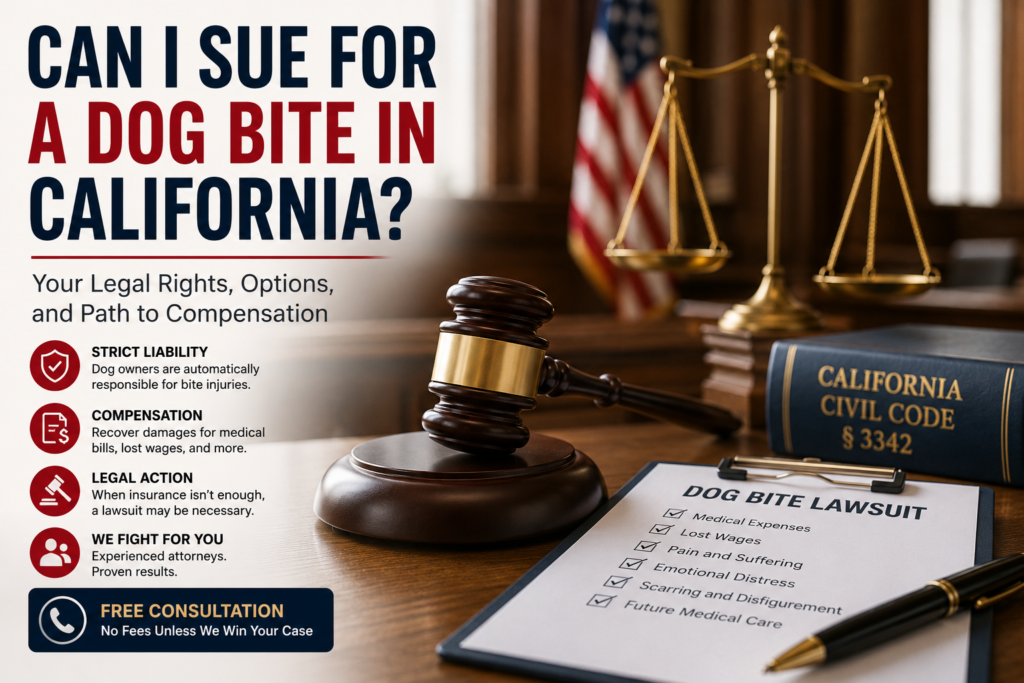
California Civil Code Section 3342 establishes strict liability for dog owners. Under this statute, you do not need to prove the owner was careless. You do not need to show the dog had ever bitten anyone before. You do not need to demonstrate that the owner had any warning their dog was dangerous. What you need to establish is straightforward: a dog bit you, you were in a public place or lawfully on private property when it happened, and you suffered injuries as a result.
That is the legal threshold for a valid dog bite lawsuit in California. It is intentionally low for victims because the California legislature made a deliberate policy decision: dog owners, not the people their dogs injure, should bear the financial consequences of those attacks.
What “Lawfully on Private Property” Means
The strict liability protection under California law extends to anyone who was legally present at the location of the bite. Guests at a home, customers at a business, delivery workers, mail carriers, utility workers performing authorized duties, and anyone else with an invitation or legal right to be in that space qualifies. The law’s protection is not limited to public parks and sidewalks — it applies in backyards, apartment common areas, restaurants, and anywhere else a person had a right to be when the attack occurred.
The Difference Between an Insurance Claim and a Lawsuit
Before addressing when to file a lawsuit, it is worth clarifying the distinction between an insurance claim and formal litigation — because many victims conflate the two or assume they are the same process.
An insurance claim is an administrative process. Your attorney submits a demand to the dog owner’s homeowner’s or renter’s insurer, negotiations occur, and the parties attempt to reach a settlement without involving the courts. This resolves the majority of California dog bite cases. It is generally faster than litigation, less resource-intensive, and can produce excellent outcomes when the insurer engages in good-faith negotiations and the damages are well-documented.
A lawsuit is a formal legal proceeding filed in the California Superior Court. It becomes the appropriate path when an insurer refuses to make a fair settlement offer, disputes liability, undervalues the damages, or delays the process unreasonably. Filing a lawsuit does not mean your case will necessarily go to trial — the majority of litigated cases still settle before a jury hears them, often at significantly higher values than what the insurer offered before litigation began. But it does mean the formal judicial process has been initiated, with all the discovery, depositions, motions, and ultimately trial preparation that entails.
Understanding this distinction matters because some victims make the mistake of waiting to explore their legal options until an insurance company has already pushed them into a corner. Early attorney involvement — before any recorded statements are given and before any settlement offers are made — preserves your ability to use both the insurance claim process and formal litigation as tools, rather than being locked into a position that limits your options.
When Filing a Dog Bite Lawsuit in California Makes Sense
Not every dog bite case requires a lawsuit. But several specific circumstances consistently point toward formal litigation as the right approach for a California dog bite victim.
The Insurance Company Denies or Disputes Your Claim
Insurers deny dog bite claims for various reasons — breed exclusions in the policy, arguments that the victim provoked the dog, claims that the victim was trespassing, or disputes about the extent of the injuries. When a denial is improper — and many are — a formal dog bite lawsuit in California is often what is needed to force a proper resolution. The courts apply California’s strict liability standard without the insurer’s self-interested interpretation of what the evidence means.
The Settlement Offer Does Not Cover Your Full Damages
Insurance companies routinely make settlement offers that cover past medical bills but ignore future medical costs, undervalue pain and suffering, and fail to account for permanent scarring, lost earning capacity, or psychological trauma. When the gap between what an insurer offers and what your documented damages are actually worth is significant, filing a lawsuit creates the leverage needed to close that gap. Discovery produces additional evidence. The prospect of a jury verdict — particularly in a sympathetic case with clear liability and serious injuries — motivates insurers to reconsider positions they held firmly during pre-litigation negotiations.
Your Damages Are Severe
Cases involving serious injuries — surgeries, nerve damage, permanent disfigurement, lengthy rehabilitation, significant psychological impact — typically have damage values that exceed what insurance companies settle willingly without litigation pressure. If your dog attack injuries required hospitalization, surgical intervention, or have left you with permanent physical or psychological consequences, formal litigation is often the path that produces the recovery your injuries actually warrant.
Multiple Parties Share Responsibility
When a dog bite involves both the dog owner and a third party — a landlord who knew about the dangerous dog, a property management company that failed to enforce lease restrictions, or a business that permitted an unsafe animal on its premises — coordinating claims against multiple defendants and their respective insurers is a process that the court system handles more effectively than informal insurance negotiations. A formal lawsuit against all responsible parties preserves the ability to recover from every available source simultaneously.
Evidence That Strengthens a California Dog Bite Lawsuit
The legal threshold for a dog bite lawsuit in California is low, but the evidence supporting your specific damages is what determines what you recover. Building a strong evidentiary record begins at the time of the attack — and continues through every stage of your medical treatment.
Medical Records and Bills
Your complete medical documentation — from the initial emergency treatment through every follow-up appointment, specialist consultation, prescription, and projected future care plan — is the backbone of your damages claim. These records establish both what the attack cost you and what it will continue to cost going forward. Gaps in medical treatment create gaps in the damages picture that insurers and defense attorneys exploit.
Animal Control and Incident Reports
The official animal control report creates an independent government record of the attack and may reveal prior bite history involving the same dog. If the dog had previously been reported as dangerous or had bitten before, that history is directly relevant to the value of your claim and may support additional damages categories in some circumstances.
Photographs and Visual Documentation
Photographs taken immediately after the attack — before any cleaning or treatment — carry significant persuasive impact in litigation. Continued photographic documentation throughout recovery creates a visual timeline that establishes the depth of the injury’s impact more powerfully than written descriptions in medical records. If your injuries left permanent scarring, professional documentation of that scarring by a plastic surgeon or reconstructive specialist adds further evidentiary weight.
Witness Statements
Anyone who witnessed the attack, observed the dog’s behavior before the incident, or can speak to the dog owner’s awareness of the animal’s dangerous tendencies provides testimony that strengthens both liability and damages. Witness statements are most reliable and most credible when gathered promptly, before memories fade or witnesses become difficult to locate.
Documentation of Financial Impact
Pay records, employer statements, and tax history documenting lost wages are essential to recovering income-related damages. For more serious cases, vocational expert assessments addressing future earning capacity and life care planner projections covering long-term medical costs build the damages picture beyond what past bills alone can establish.
California’s Statute of Limitations for Dog Bite Lawsuits
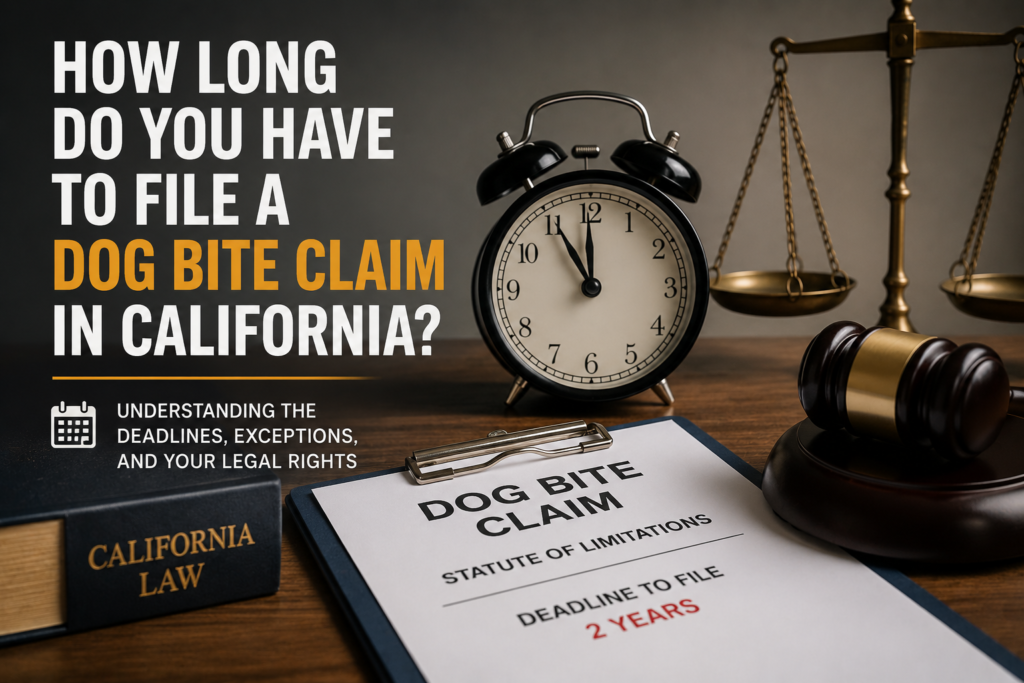
California law gives dog bite victims a defined window to file a lawsuit. Under California Code of Civil Procedure Section 335.1, the statute of limitations for personal injury claims — including dog bite lawsuits — is two years from the date of the attack. Filing after this deadline results in permanent loss of the right to pursue compensation, regardless of the strength of the underlying claim.
Two important exceptions apply. For minor victims, the statute of limitations is generally tolled — paused — until the child turns 18, meaning the two-year clock begins on their eighteenth birthday. For bites that occurred on government property, the California Government Claims Act requires that a government tort claim be filed within six months of the incident, with specific procedural requirements that differ from standard civil litigation.
While two years may seem like comfortable time, the reality is that cases built on evidence gathered promptly are consistently stronger than those assembled after months of delay. Witness availability, surveillance footage retention, and the freshness of the medical picture all degrade over time. Contacting an attorney well before the deadline — ideally within weeks of the attack — is not urgency for its own sake. It is the practical step that preserves the full value of your case.
Common Mistakes That Weaken a California Dog Bite Lawsuit
Accepting an Early Insurance Settlement
Insurance companies sometimes extend early, seemingly reasonable settlement offers before the full scope of injuries is clear and before future medical costs can be accurately projected. Accepting any settlement and signing a release permanently closes the claim. If complications develop — additional surgeries, infection treatment, psychological effects — there is no recourse. An attorney must review any offer in the context of fully documented damages before any settlement is considered final.
Giving Recorded Statements Without Counsel
Every word in a recorded statement becomes potential ammunition for comparative fault arguments. Even well-intentioned descriptions of the incident can be reframed by insurance defense attorneys to suggest the victim contributed to the attack. No recorded statement should be given to any insurer before speaking with an attorney.
Gaps in Medical Treatment
When a victim delays treatment, skips follow-up appointments, or stops treatment before reaching maximum medical improvement, insurers argue that the injuries were either not serious to begin with or that the victim failed to mitigate their damages. Consistent, uninterrupted medical treatment documented throughout recovery is essential to a well-supported lawsuit.
Waiting Too Long to Contact an Attorney
Beyond the statute of limitations concern, waiting compromises evidence. Our attorneys at San Diego dog bite claim services regularly see cases where critical surveillance footage was overwritten, key witnesses had relocated, and animal control records had become harder to access — all because the victim waited months before seeking legal advice. Earlier involvement produces stronger cases.
The Dog Bite Lawsuit Timeline in California
Once a lawsuit is filed in California Superior Court, the case enters a structured litigation process. The initial filing triggers a response period for the defendant, followed by the discovery phase — during which both sides exchange written questions, documents, and conduct depositions of witnesses and experts. For cases in San Diego County, court scheduling, the volume of pending cases, and the complexity of the specific matter all affect how quickly the case moves.
Most California dog bite lawsuits settle during or after discovery, when the evidence picture is fully developed and both sides have a realistic assessment of how a jury would likely view the case. Cases that do not settle proceed to trial, where a jury determines both liability and the appropriate compensation. The complete process from filing to resolution — whether by settlement or verdict — typically spans one to two years for litigated cases, though timelines vary.
Frequently Asked Questions — Suing for a Dog Bite in California
Can I sue even if the dog has never bitten anyone before?
Yes. California’s strict liability law under Civil Code Section 3342 makes prior bite history completely irrelevant to your right to sue. The fact that a dog bit you while you were lawfully present at the location of the attack is the entire legal basis you need. California eliminated the “one free bite” standard that other states still use.
Can I sue if the dog bite happened at a friend’s house?
Yes. The relationship between you and the dog owner does not affect your legal right to pursue a claim. In most residential cases, the claim is directed against the homeowner’s or renter’s insurance policy — not against the individual personally. Filing a claim uses coverage the owner pays for and that exists precisely for this purpose. An experienced attorney can help navigate this sensitively while protecting your right to full compensation.
What if the dog owner says I provoked their dog?
Provocation is the most common defense raised by dog owners and their insurers in California bite cases. It requires demonstrating that the victim deliberately and knowingly caused the dog to bite. In genuine cases where a victim had no threatening or provocative interaction with the dog, this defense typically fails. However, even if some degree of comparative fault is assigned, California’s pure comparative fault system allows recovery of damages reduced proportionally by your percentage of fault — not a complete bar to recovery.
What if I was bitten at work in California?
Workers bitten while performing their job duties — delivery drivers, mail carriers, service technicians, home health workers — may pursue both a personal injury lawsuit against the dog owner under California Civil Code Section 3342 and a workers’ compensation claim through their employer. These two paths can be pursued simultaneously in most cases. An attorney can advise on coordinating both claims to maximize total recovery.
Do I need a lawyer to file a dog bite lawsuit in California?
You are not legally required to have an attorney, but the practical impact of professional representation is significant. Dog bite defendants and their insurers retain experienced defense counsel. Self-represented plaintiffs consistently recover less — often substantially less — than represented victims, particularly in litigated cases where discovery, motion practice, and trial preparation require specific legal expertise. California dog bite attorneys work on contingency, meaning there are no upfront costs and no attorney fees unless recovery is obtained.
Talk to a California Dog Bite Lawsuit Attorney Today — Free
If a dog bit you in California and you are wondering whether you have grounds for a lawsuit, the most reliable answer comes from a direct conversation about your specific injuries, the circumstances of the attack, and the available evidence. General articles provide frameworks; attorneys provide answers.
Our team at dogbitelawyersandiego.com represents dog bite victims throughout San Diego County — from Downtown San Diego to Chula Vista to El Cajon and everywhere in between. We offer a completely free dog bite case evaluation — no upfront costs, no obligation, no attorney fees unless we recover compensation for you.
For additional information about the California dog bite legal process, visit our legal resource blog where you will find the complete series covering every stage of a California dog bite claim — from the immediate aftermath through settlement and, when necessary, through trial.