Should You Talk to the Insurance Adjuster After a Dog Bite? In California this is one of the most important questions you will face in the days immediately following an attack — and the answer has direct financial consequences that most victims do not fully understand until it is too late to reverse them. The insurance adjuster who calls you is not a neutral party. They are a trained claims professional whose performance is measured, at least in part, by how effectively they resolve claims within budget. That call is not a courtesy — it is the beginning of the insurer’s claims management strategy.
This article explains exactly how insurance adjusters operate after a California dog bite, the tactics they use during initial contact, what you should and should not say, and why legal representation before that first conversation is the single most protective step you can take. If you have been following our California dog bite legal series — covering everything from immediate steps after an attack through the mistakes that hurt California dog bite claims — this article goes deep on the insurance company side of the equation.
Should You Talk to the Insurance Adjuster After a Dog Bite in California — The Direct Answer
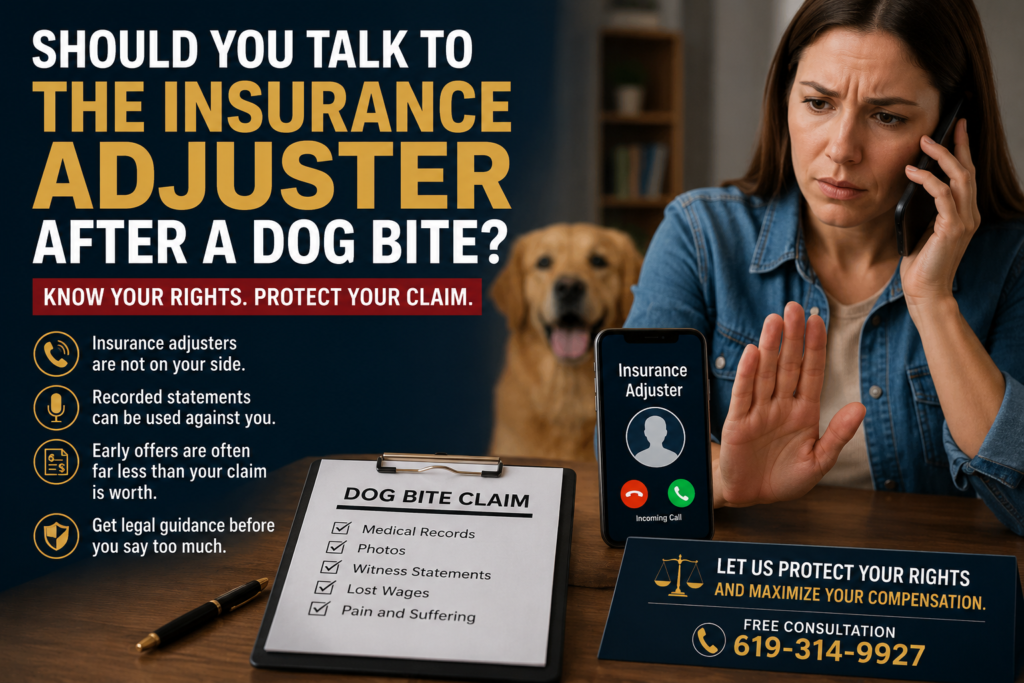
The short answer is: not without an attorney. The longer answer is that understanding why leads to a clearer picture of how the entire claims process works — and why unrepresented victims consistently recover less than their claims are actually worth.
In California, dog bite liability is governed by Civil Code Section 3342, which establishes strict liability for dog owners. Liability is not the complicated part of most California dog bite claims. Damages are. How thoroughly your injuries are documented, how accurately your future costs are projected, whether any comparative fault is assigned to you, and how effectively the full value of your claim is presented and defended in negotiation — these are the variables that determine what you actually recover. Every single one of them is affected by what you say to an insurance adjuster before an attorney is involved.
Why the Insurance Company Calls So Quickly
One of the first things California dog bite victims notice is how fast the dog owner’s insurance company contacts them — sometimes within 24 to 48 hours of the attack. This speed is not accidental and it is not driven by concern for the victim’s wellbeing, despite how the conversation may be framed.
Adjusters contact victims early for several strategic reasons. The earlier in the process they speak with you, the less information you have: you may not know the full extent of your injuries, you have not yet consulted an attorney, you have not yet received a complete medical assessment, and you have not had time to research your rights under California law. All of that information asymmetry works in the insurer’s favor. Early contact also allows the adjuster to shape the narrative of what happened before anyone else has the opportunity to do so professionally on your behalf.
Early settlement offers — which some adjusters extend during that first call or shortly afterward — exploit the same dynamic. As our guide on average dog bite settlements in California explains, early offers routinely cover past medical bills while ignoring future treatment costs, undervaluing pain and suffering, and failing to account for the full impact of permanent scarring, lost wages, and psychological trauma. Accepting an early offer closes the claim permanently. There are no second chances after a release is signed.
The Recorded Statement — What It Is and Why It Matters
During the initial adjuster contact, or in a follow-up call, the adjuster will almost certainly ask to record a statement about the incident. They will present this as standard procedure — a routine part of processing the claim. What they will not explain is how that recording is actually used.
A recorded statement is not simply a factual account of what happened. It becomes a permanent document that insurance defense teams analyze for every potentially exploitable element. Adjusters are trained to listen for specific categories of information during these conversations: anything that might suggest the victim contributed to the attack, any characterization of the dog’s behavior that implies provocation, any description of the victim’s pre-bite movements or actions that could be framed as comparative fault, and any description of injuries that sounds less severe than the medical records ultimately show.
In California, comparative fault — even a small percentage assigned to the victim — reduces compensation proportionally. A statement that describes moving toward the dog, making eye contact, bending down near it, or any behavior that can be characterized as provoking or startling the animal gives the insurer material for a comparative fault argument that may not otherwise exist. These statements are permanent, and they are not easily walked back once they are in the record.
What Adjusters Are Listening for in a Recorded Statement
Experienced California dog bite attorneys recognize the specific lines of questioning adjusters use in recorded statements with California victims. Common areas of focus include the victim’s relationship to the dog — whether they had interacted with it before, whether they were familiar with the animal, and whether the owner had ever expressed concern about the dog’s behavior. Questions about what the victim was doing immediately before the bite often probe for any action that could be characterized as provoking or startling the animal. Questions about the immediate aftermath probe for any minimization of injury — phrases like “it wasn’t that bad at first” or “I thought it would be fine” that can later be used to dispute severity.
Adjusters also ask about medical treatment timing and consistency. If you waited more than a few hours before seeking care, or if there are gaps in your treatment, they note those details. They may also ask questions about your general health, prior injuries, and pre-existing conditions — sometimes through broad medical authorization requests that go far beyond what is relevant to your dog bite claim.
Common Insurance Adjuster Tactics in California Dog Bite Claims
The Sympathy Opening
Almost every adjuster call begins with expressions of concern — an apology on the insurer’s behalf for what you experienced, questions about how you are feeling, and language designed to establish rapport. This is not personal warmth. It is a professionally trained approach designed to lower the victim’s guard and encourage more open, less guarded communication than a more formal setting would produce. The warmth of the opening conversation has no bearing on the rigor with which your statement will be analyzed afterward.
Minimizing the Severity of Injuries
Adjusters frequently probe for language they can use to argue that injuries were less severe than claimed. Questions like “How are you feeling now?” asked early in recovery, before the full extent of damage is known, can produce answers that conflict with later medical documentation. A victim who says “I’m getting better, I think” three days after a serious bite — before infection complications have emerged, before a nerve damage assessment has been completed — has produced a statement that can be used to suggest the injury resolved quickly.
The Early Settlement Offer as a Closing Tactic
When adjusters sense that a victim is unrepresented, financially pressured by medical bills, and unfamiliar with the full value of their claim, early settlement offers are a deliberate closing tactic. The offer is typically framed as generous relative to what has been spent so far — “We want to take care of your medical bills and get this resolved quickly for you.” What it does not reflect is future medical costs, non-economic damages, income loss, or any of the value components that require full documentation and professional advocacy to capture. As discussed in our guide on how homeowners insurance covers dog bite claims, the insurer’s goal is to close the claim at the lowest defensible figure.
Social Media Monitoring
Adjusters and insurance defense investigators routinely monitor the social media accounts of California dog bite claimants throughout the claims process. Any post that appears to contradict the severity of your injuries — a photograph at a social event, a post about an activity, anything suggesting physical capability inconsistent with your claimed limitations — can be collected as evidence and used in settlement negotiations or litigation. As our article on evidence that strengthens a dog bite claim explains, social media suspension during the claims process is one of the simplest and most consistently overlooked protective steps available to victims.
Broad Medical Authorization Requests
Insurers often send medical authorization forms requesting access to a claimant’s complete medical history — not just records related to the dog bite. Signing a broad authorization gives the insurer access to pre-existing conditions, prior injuries, mental health history, and other unrelated health records that can be mined for arguments that current symptoms are attributable to pre-existing factors rather than to the attack. No medical authorization should be signed without attorney review to ensure its scope is appropriately limited to the current claim.
What You Can and Should Provide — Without an Attorney
There is a meaningful difference between confirming basic administrative facts and giving a substantive recorded statement about the incident, your injuries, and your activities. If you do speak with an adjuster before retaining an attorney, there is minimal information you can provide without significant risk: your name, contact information, confirmation that an incident occurred, and the name of any treating medical provider you have already seen. That is approximately where the safe territory ends for an unrepresented victim.
You are not legally required to provide a recorded statement before the insurer investigates and evaluates your claim. Politely declining a recorded statement — “I’d like to speak with an attorney before I give any recorded statement” — is a legally protected response that no insurer can penalize you for. The claim will proceed regardless.
How Attorney Involvement Changes the Adjuster Dynamic
When an attorney enters a California dog bite claim, the adjuster’s approach shifts fundamentally. All communications are directed through the attorney rather than to the victim directly. There are no more calls designed to elicit unguarded statements. No medical authorizations are signed without scrutiny. No settlement discussions occur without the full damages picture in place. And the adjuster — and the insurer’s team behind them — is now aware that this claim has professional representation, which changes the calculus on how aggressively they can minimize the offer before litigation becomes a credible risk.
Attorneys handling dog bite claims in San Diego and across North County — including cases in Oceanside, Escondido, and Santee — document the full damages picture before any demand is submitted: complete medical records and future care projections, income loss documentation, photographic evidence of injuries and scarring, mental health treatment records, and a legal narrative that connects the liability clearly to every element of the claimed damages. That documentation, presented by a professional with credible litigation readiness, produces different negotiating outcomes than an unrepresented victim’s direct conversation with an adjuster.
The Claim Valuation Process — What Adjusters Actually Look At
Understanding how adjusters evaluate claim value helps victims understand why the evidence they gather — and the statements they make — matter so much to the final outcome. Adjusters assess liability, which in a California strict liability dog bite case is rarely a genuine dispute. Their real focus is damages valuation: how much does this claim actually cost to resolve?
Documented medical expenses are the most straightforward component — they are what they are on the billing statements. Future medical costs require physician projections; without those projections in the file, adjusters assign lower values. Pain and suffering is evaluated against the documented treatment record, the nature and permanence of injuries, and comparable cases in the same jurisdiction. Scarring is evaluated using photographic documentation and, for significant disfigurement, specialist assessments. Income loss requires payroll documentation and, for future impact, expert analysis.
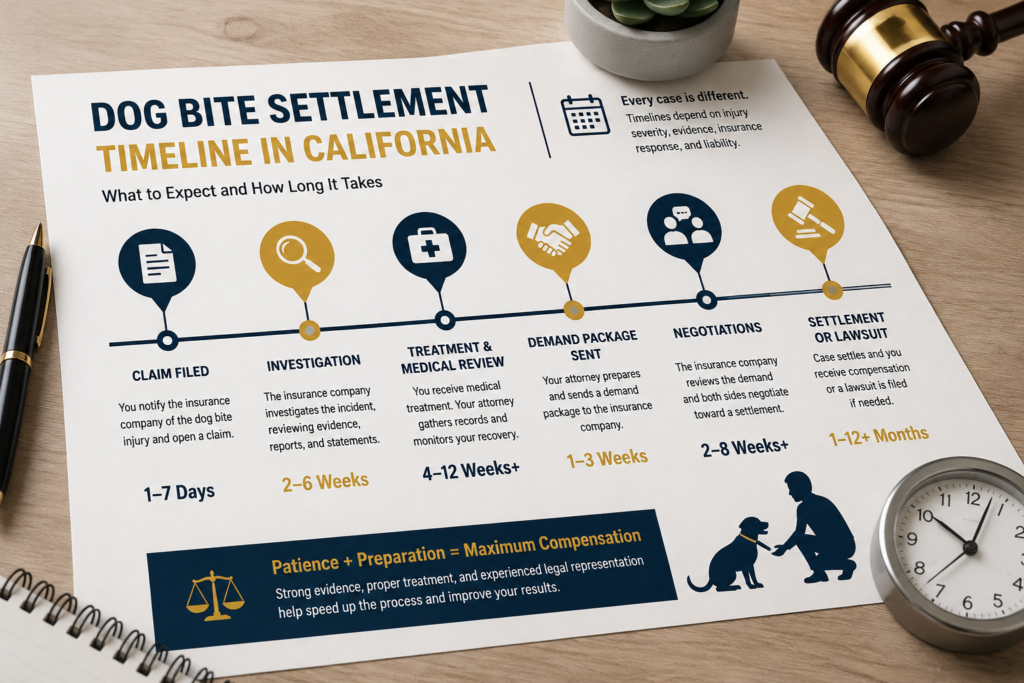
Every gap in documentation is a tool the adjuster uses to justify a lower total. Every element of the claim that is well-supported removes that tool from their hands. The relationship between documentation quality and final settlement value is direct and consistent across California dog bite cases — which is precisely why our guide on how long dog bite settlements take in California emphasizes waiting for maximum medical improvement before finalizing any demand.
When an Attorney Is Absolutely Essential Before Any Adjuster Contact
There are specific circumstances in which attorney involvement before any adjuster contact is not just advisable but critical. Cases involving severe injuries — surgery, nerve damage, hospitalization, permanent scarring — have damage values that adjusters are specifically trained to suppress in early settlement discussions. Cases involving children require special handling because the full long-term impact of injuries on a developing minor’s life is not apparent in the early weeks after an attack, and early statements about a child’s condition can lock in an incomplete picture of harm. Our child dog bite attorneys address this dynamic specifically in pediatric cases.
Cases involving premises liability — rental properties, apartment complexes, commercial businesses — involve potential claims against multiple parties with multiple insurance policies. An unrepresented victim speaking only with the dog owner’s insurer may never learn that a property management company’s commercial policy provides an additional and often more substantial source of recovery. An attorney identifies that coverage before any settlement discussions begin.
Frequently Asked Questions — Talking to Insurance Adjusters After a Dog Bite in California
Is it illegal to refuse to give a recorded statement to the insurance company?
No. Declining to give a recorded statement is entirely legal and is not grounds for denial of a valid claim. Insurance companies cannot require a recorded statement as a condition of processing a claim. Politely declining and stating that you wish to consult an attorney first is a completely protected response. No adjuster can penalize you for exercising that right.
What if I already gave a recorded statement before I knew I shouldn’t?
The statement is now part of the record, but it is not necessarily fatal to your claim. An attorney can review the statement, assess what if any comparative fault arguments it might support, and build the rest of the evidentiary record to contextualize and counterbalance any problematic content. The most important thing at this point is to stop all further direct contact with the insurer and consult an attorney before any additional statements are made or documents are signed.
What if the adjuster says the settlement offer is only valid for a limited time?
Artificial deadlines on settlement offers are a pressure tactic. No insurer can legally extinguish a valid claim by withdrawing a settlement offer — the claim exists under California law and the statute of limitations continues to run regardless of whether the insurer has made or withdrawn offers. An attorney will tell you clearly whether a given offer reflects the real value of your claim before advising on any response.
What does an adjuster do with the information I provide?
Everything you tell an adjuster — whether in a recorded statement or in casual conversation — is documented in the claims file and can be used in settlement negotiations and litigation. Adjusters are not obligated to interpret your statements charitably. They are evaluating what you say for any language that can support a lower damages valuation, a comparative fault argument, or a basis for disputing the severity or causation of your injuries.
Should I sign the medical authorization the insurance company sent me?
Not without attorney review. Broad medical authorizations give the insurer access to your complete medical history — including conditions unrelated to the dog bite — which provides material for arguments that your current symptoms predate the attack. Any authorization should be reviewed and, if necessary, limited in scope by your attorney before it is signed.
Protect Your Claim Before You Pick Up the Phone
The moment a dog bite occurs in California, a claims process has effectively begun — on the insurance company’s side. Their team is already organized. Their adjuster is already assigned. Their strategy is already in motion. The best protection available to a California dog bite victim is having their own professional representation in place before that first call is returned.
Our team at dogbitelawyersandiego.com is available 24/7 for a completely free dog bite case evaluation. We handle all insurer communications from the first day we are retained, ensure no damaging statements are given, build the complete evidentiary record that supports maximum compensation, and negotiate from a position of documented strength. No upfront fees — no attorney costs of any kind unless we recover compensation for you. Explore our complete California dog bite legal resource library at blog.dogbitelawyersandiego.com.