California dog bite law is among the strongest and most clearly written victim-protection statutes in the United States — and understanding exactly what it says, what it requires, and what it does not require is the foundation of every successful dog bite claim in this state. Whether you were bitten in a park in Downtown San Diego, at a neighbor’s home in Chula Vista, or on a sidewalk anywhere else in California, the same law governs your right to compensation — and it is unambiguous about where responsibility lies.
This article is the definitive guide to California dog bite law as it applies to injury victims and their families. It covers the core statute, the strict liability rule, the exceptions that insurance companies commonly try to exploit, the full range of compensation available, and the deadlines that determine whether a claim can be pursued at all. If you have already read our earlier guides on what happens after a dog bite in California or whether you can sue for a dog bite in California, this article provides the complete legal foundation those guides build on.
California Dog Bite Law — The Core Statute Explained
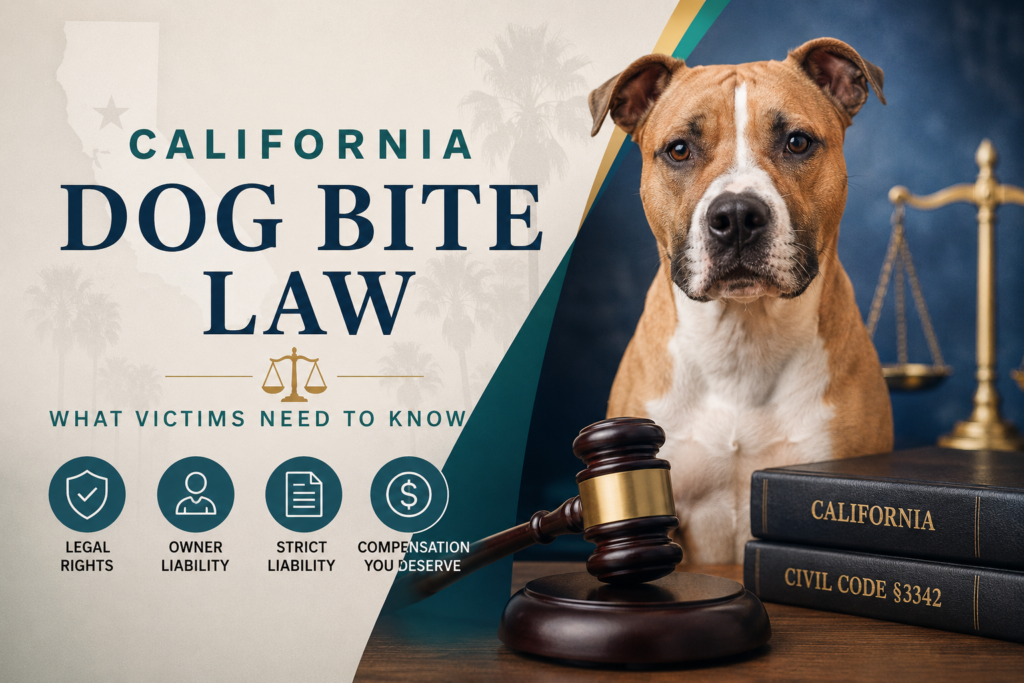
The primary statute governing dog bite liability in California is California Civil Code Section 3342. The relevant portion reads:
“The owner of any dog is liable for the damages suffered by any person who is bitten by the dog while in a public place or lawfully in a private place, including the property of the owner of the dog, regardless of the former viciousness of the dog or the owner’s knowledge of such viciousness.”
Every meaningful word of that sentence matters. Owners are liable. The bite must occur in a public place or a location where the victim was lawfully present. Prior viciousness is irrelevant. The owner’s knowledge of prior viciousness is irrelevant. The statute is constructed to place the full financial burden of dog bite injuries on dog owners — not on the people their animals harm.
This is California’s strict liability rule for dog bites, and it represents a fundamental departure from how many other states approach the same legal question. Understanding it fully — including its reach and its limits — is essential for any dog bite victim in California.
The Strict Liability Rule — What It Means in Practice
Strict liability means liability without fault. In most personal injury cases, a victim must prove that the defendant was negligent — that they acted carelessly, failed to take reasonable precautions, or knew about a risk and ignored it. California’s strict liability dog bite rule eliminates that requirement entirely.
Under California Civil Code Section 3342, you do not need to prove that the dog owner failed to use reasonable care. You do not need to show that the owner knew the dog was dangerous. You do not need to establish that the dog had ever behaved aggressively before — toward you or anyone else. The “one free bite” rule that still applies in some states — a concept that allowed dog owners to escape liability for a first attack on the grounds that they had no warning — does not exist in California. The very first bite triggers strict liability, just as fully as the tenth bite would.
What this means practically for a California dog bite victim is that establishing liability — the legal question of who is responsible — is far more straightforward than it would be in other jurisdictions. The complexity in most California dog bite cases is not whether the owner is liable. It is the full documentation of damages, the identification of all available insurance coverage, and the professional presentation of a claim that captures everything the law entitles the victim to recover.
What “Lawfully Present” Means Under California Law
The strict liability protection extends to anyone who was legally present at the location of the bite. This includes individuals who were expressly or implicitly invited onto private property — guests, customers at a business, neighbors visiting a home. It includes individuals who had a legal right or official authorization to be present — mail carriers, delivery drivers, utility workers, emergency responders, and home health workers. It includes any person in a public place — parks, sidewalks, trails, beaches, and public recreational areas throughout California.
The protection is specifically withheld from trespassers — individuals who were on private property without permission, authorization, or legal right at the time of the bite. This exception is the one most commonly invoked by insurance defense teams, and it is narrower than it sounds. A child who wanders onto a neighboring property does not necessarily meet the legal definition of a trespasser. A person who enters private property in an emergency does not meet that definition. And in some circumstances involving known child trespassers, the attractive nuisance doctrine creates an independent basis for liability even when strict liability under Section 3342 does not technically apply.
Exceptions and Defenses to California Dog Bite Liability
The Provocation Defense
The provocation defense is the most frequently raised challenge to California dog bite claims. If an owner can demonstrate that the victim deliberately provoked the dog — intentionally causing the animal to bite through actions the victim knew or should have known would produce that response — California courts recognize this as a complete or partial defense to strict liability.
The important word in that sentence is “deliberately.” Accidentally startling a dog, unintentionally approaching it in a way that caused the animal anxiety, or simply moving in the dog’s proximity does not constitute provocation under California law. Provocation requires intentional conduct directed at the animal. Insurance adjusters sometimes attempt to characterize any interaction between the victim and the dog as provocation — “you reached toward it” or “you made direct eye contact” — but these arguments rarely survive legal scrutiny when challenged by an experienced attorney. As discussed in our guide on who pays for dog bite injuries in California, provocation claims from insurers are a standard tactic to reduce payouts rather than a genuine legal barrier.
Assumption of Risk
In limited circumstances — primarily involving veterinary professionals, groomers, kennel workers, and others who work with dogs as part of their occupation — California courts have recognized an assumption of risk defense. The doctrine applies when someone voluntarily assumes a known risk as part of a professional role. This exception is narrowly applied and does not affect the vast majority of dog bite cases involving members of the public.
Government and Military Working Dogs
California law specifically exempts military and police working dogs from strict liability under Section 3342 when those dogs are used in law enforcement or military operations. This exemption is limited to official deployment of trained working animals and does not apply to privately owned dogs used in any context.
California Dog Bite Law and Child Victims
Dog bite cases involving children are governed by the same strict liability statute as adult cases, but several additional legal considerations apply that make these claims more complex — and often more valuable.
First, the provocation defense is significantly harder to establish when the alleged provoker is a young child. California courts apply an age-appropriate standard of conduct when evaluating whether a child’s behavior constituted provocation. A four-year-old who pulls a dog’s ear is behaving in a way that is entirely foreseeable for a child of that age — it is the dog owner’s responsibility to ensure that their animal is not in a situation where such interaction can occur, not the child’s responsibility to know better.
Second, the statute of limitations is tolled for minor victims. Under California law, the two-year filing deadline does not begin running until the child reaches the age of 18, meaning an attack that occurs in childhood can still be pursued legally into the victim’s early adulthood. Our detailed guide on California dog bite claim deadlines covers this tolling provision in detail.
Third, the long-term damage calculation in child dog bite cases is inherently higher than in adult cases because the period over which injuries will affect the victim’s life is longer. Permanent scarring acquired in childhood spans more decades. Psychological trauma experienced during formative years has more developmental consequences. Future medical cost projections cover more years of life. Our child dog bite attorneys specifically account for all of these extended-impact factors when building compensation demands for minor victims.
Landlord and Property Owner Liability Under California Law
California strict liability under Civil Code Section 3342 runs against the dog’s owner. But California premises liability law — a separate and complementary legal doctrine — can extend responsibility to property owners who are not themselves the dog’s owner when those property owners had prior knowledge of a dangerous animal on their premises and failed to take reasonable action to protect others.
For landlords who knowingly permitted a dangerous tenant dog to remain on the property despite warnings, for apartment management companies that received multiple complaints about a specific animal and took no action, and for property managers who failed to enforce lease clauses prohibiting dangerous pets, California premises liability law creates a separate and often substantial avenue of compensation. Commercial general liability policies held by property management companies typically carry significantly higher limits than individual renter’s insurance, making this dual-track claim strategy particularly valuable in cases arising from rental housing incidents. Our premises liability dog bite attorneys pursue this angle as a standard part of every applicable case.
Compensation Available Under California Dog Bite Law
California law allows dog bite victims to recover the full range of compensatory damages. These fall into two categories: economic damages reflecting measurable financial losses, and non-economic damages reflecting the human cost of the injury beyond what receipts and pay stubs can quantify.
Economic Damages
Economic damages in California dog bite cases include all past and future medical expenses — emergency treatment, hospitalization, surgical procedures, specialist consultations, physical therapy, prescription medications, and projected future care including additional surgeries, scar revision procedures, and ongoing psychological treatment. They include lost wages for all work time missed due to the injury and medical appointments, and future lost earning capacity where injuries permanently affect the victim’s ability to work at their prior level. Out-of-pocket costs directly caused by the injury are also recoverable.
Non-Economic Damages
Non-economic damages in California dog bite cases include pain and suffering — compensation for the physical experience of the injury and recovery — emotional distress and psychological trauma including documented PTSD, anxiety disorders, and phobias that develop following a violent animal attack, permanent scarring and disfigurement as a standalone damage category separate from medical costs, and loss of enjoyment of life for activities and experiences the victim can no longer participate in due to their injuries. California imposes no statutory cap on pain and suffering in personal injury cases, which means serious injury claims can carry substantial non-economic damage values. For severe dog attack injuries, these non-economic components frequently represent the largest share of the total claim value.
Insurance Claims and California Dog Bite Law
In practice, most California dog bite claims are resolved through the dog owner’s homeowner’s or renter’s insurance personal liability coverage. California’s strict liability statute provides the legal foundation for these claims — the insurer cannot dispute the owner’s liability by arguing the dog was previously well-behaved or that the owner took precautions. The insurer’s evaluation focuses on damages rather than liability in the vast majority of cases.
What insurance companies can and do dispute is the value of those damages. Future medical cost projections, pain and suffering valuations, and income loss calculations are all subject to insurer challenge, and adjusters are professionally trained to minimize each component. This is the context in which legal representation matters most — not in establishing that the owner is liable, but in ensuring that the full documented value of every damage category is presented, defended, and ultimately recovered.
Deadlines — The California Statute of Limitations for Dog Bites
California Code of Civil Procedure Section 335.1 establishes a two-year statute of limitations for personal injury claims. For dog bite victims, this two-year clock generally begins on the date of the attack. Missing this deadline eliminates the right to pursue compensation through the courts, regardless of how strong the underlying claim might be.
Two critical exceptions apply. For minor victims, the two-year clock does not begin until the child’s eighteenth birthday. For bites occurring on government property — city parks, public beaches, municipal facilities — the California Government Claims Act requires an administrative claim to be filed within six months of the incident, not two years. That six-month window applies to any case where a government entity shares responsibility for the attack, and missing it permanently eliminates that avenue of recovery.
Practical advice: contact an attorney as early as possible after a dog bite, regardless of which deadline ultimately applies. Evidence degrades rapidly. Surveillance footage is overwritten. Witnesses become unavailable. Animal control records are most accessible shortly after an incident. Every week of delay costs something — and the two-year window is not a comfortable horizon. It is a hard cutoff with permanent consequences.
Common Misconceptions About California Dog Bite Law
Misconception: The Dog Gets “One Free Bite”
This is the most persistent myth in California dog bite law. The one-bite rule — which does exist in some other states — holds that a dog owner is not liable for a first bite unless they had prior knowledge of the animal’s dangerous behavior. California eliminated this standard entirely when it enacted Civil Code Section 3342. There is no first free bite in California. Strict liability applies from the moment the dog first bites anyone.
Misconception: The Owner Isn’t Responsible If They Tried to Restrain the Dog
Strict liability is not reduced or eliminated by the owner’s attempts at precaution. A dog on a leash that breaks free and bites someone triggers the same liability as an unsecured dog. An owner who took every reasonable precaution but whose dog bit someone anyway is still strictly liable under California law. The fact of the bite, combined with the victim’s lawful presence, is what establishes liability — not the owner’s conduct.
Misconception: You Cannot File a Claim Against a Friend or Family Member
Filing a dog bite claim against a person you know is almost always a claim against their insurance — not against them personally. Homeowner’s and renter’s insurance personal liability coverage exists specifically to pay claims like these, and the policyholder is typically not required to pay anything out of pocket. The awkwardness of the situation, while real, does not change your legal rights or the financial mechanism by which compensation is actually paid.
Misconception: Minor Injuries Don’t Justify a Claim
Any dog bite injury that required medical treatment, caused missed work, produced scarring, or generated psychological impact is a legitimate basis for a claim under California law. Severity affects value — it does not determine whether a legal right exists. A free consultation is the appropriate way to assess whether pursuing a specific claim makes practical sense given the documented damages and available coverage.
Frequently Asked Questions — California Dog Bite Law
Does California strict liability apply to dog bites that happen in dog parks?
Yes. California Civil Code Section 3342 applies in all public places, including designated dog parks throughout California. The fact that a dog park is a location where dog-to-human interaction is expected does not create an assumption of risk that eliminates strict liability. An owner whose dog bites a person in a dog park is as fully liable under California law as an owner whose dog bites someone on a public sidewalk.
What if the dog bit me while I was jogging past the owner’s property?
A public sidewalk, trail, or street is a public place under California law. A dog bite that occurs while you are jogging past private property — where you were never on the property itself — is fully covered by the strict liability statute. Your dog bite claim does not require you to have had any relationship with the property or the owner.
Can I file a claim if the dog bite did not break the skin?
California Civil Code Section 3342 specifically covers bites — defined as the dog using its teeth on a person’s body. A bite that does not break skin but causes bruising, crushing injury, or other documented harm is still a bite under the statute. Claims based on non-penetrating bites are less common and typically lower in value, but they are legally valid provided there are documented injuries.
What if the dog’s owner is a minor?
California courts treat the owner’s age differently depending on the circumstances. When a minor owns a dog, their parents may be liable through the doctrine of parental liability if they knew about or permitted the minor’s ownership of the animal. The specific facts — how the dog was acquired, who controlled it, and who was aware of its behavior — determine the appropriate defendants in these cases.
Does California dog bite law apply to dog attacks that do not involve a bite?
Civil Code Section 3342 specifically covers bites. Dog attacks that cause injury through other means — knocking someone down, scratching, or jumping — may not be covered under strict liability but can be pursued under general negligence law if the owner’s failure to control the animal was unreasonable. Our dog attack injury attorneys evaluate both strict liability and negligence theories in cases where the specific nature of the injury requires it.
How does California law apply if multiple dogs were involved in the attack?
When multiple dogs belonging to multiple owners are involved in an attack, each owner is potentially liable under California strict liability for the injuries caused by their animal. Establishing which dog caused which specific injuries can be complex in multi-dog attacks, but it does not eliminate the right to pursue claims against all owners whose animals participated in the attack. Evidence gathered at the scene — witness accounts, animal control reports, veterinary records — is essential to untangling liability in these situations.
When to Contact a California Dog Bite Lawyer
The answer that experienced California dog bite attorneys give consistently is: as soon as medically possible after the attack. Not because every case requires litigation, but because the decisions made in the days immediately following a dog bite — what you say to the dog owner’s insurance company, whether animal control is notified, what evidence is preserved, whether surveillance footage is secured before it is overwritten — have direct and irreversible effects on what the claim can ultimately recover.
Bitten by a Dog in California?
Get answers about your legal rights, potential compensation, and the next steps after a dog bite injury.