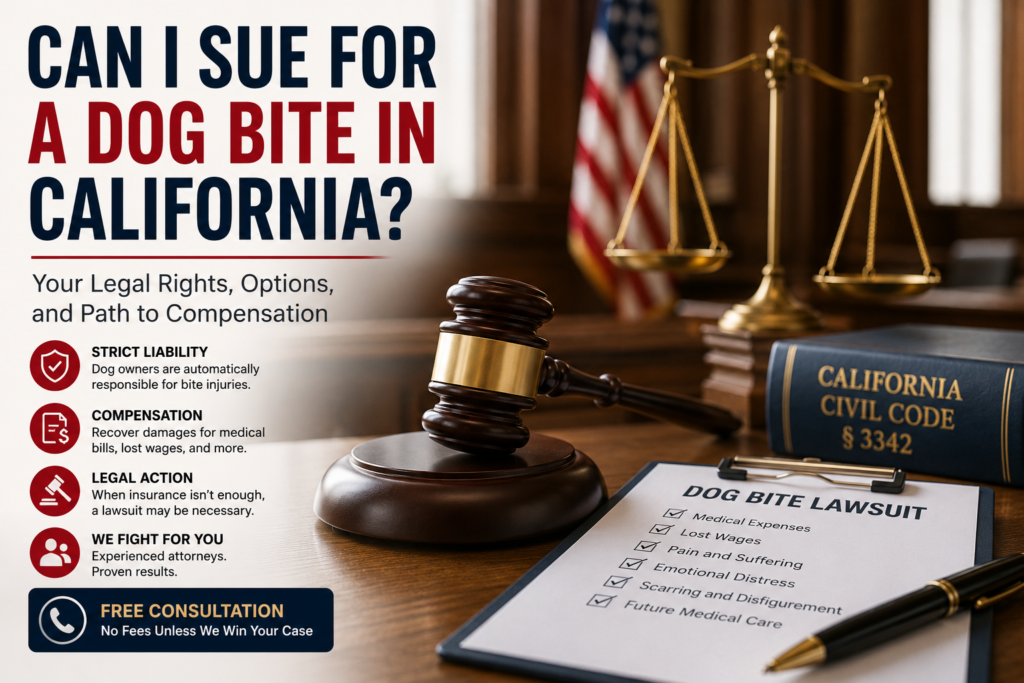
What Evidence Do You Need for a Dog Bite Claim in California? If you want to understand what evidence you need for a dog bite claim in California, start with this fundamental reality: the strength of your claim is not determined solely by the severity of your injuries. It is determined by how well those injuries — and every financial and personal loss they caused — can be proven. A serious attack with poor documentation will consistently recover less than a moderate attack with thorough, well-preserved evidence. Insurance companies know this, and they rely on evidentiary gaps to justify lower offers.
California’s strict liability law under Civil Code Section 3342 makes dog owners automatically responsible for bite injuries — but automatic liability does not mean automatic compensation at the right value. What you can prove shapes what you recover. This article covers the complete evidence picture for a California dog bite claim: what to gather, why each piece matters, the mistakes that quietly reduce settlement value, and how an experienced attorney builds the evidentiary record that supports maximum compensation.
This is the eighth installment in our California dog bite legal series. Earlier guides cover immediate steps after a dog bite, who pays for dog bite injuries, settlement value factors, and how homeowners insurance coverage works. This article addresses the evidence layer that runs through all of them.
Why Evidence Determines the Value of a California Dog Bite Claim
Liability in a California dog bite case is legally established by three elements: a dog bit you, you were in a public place or lawfully on private property, and you suffered injuries as a result. That legal threshold is relatively straightforward under California’s strict liability framework. What is far less automatic is the dollar value attached to those injuries.
Insurance adjusters evaluate dog bite claims by measuring documented damages against applicable policy limits. Every category of damages your attorney presents — medical costs, lost income, pain and suffering, scarring, psychological trauma — must be supported by evidence the insurer cannot reasonably dismiss. When evidence is weak, incomplete, or absent, the adjuster’s response is predictable: a lower offer justified by the gaps in documentation. When evidence is thorough, contemporaneous, and professionally presented, the adjustment changes accordingly.
Juries operate on the same principle. If a dog bite lawsuit in California proceeds to trial, the jury awards what the evidence supports — not what the victim believes they deserve. The evidentiary record your attorney builds from day one is the foundation on which every outcome rests, whether that outcome is a negotiated settlement or a jury verdict.
Photographs — The Most Immediate and Impactful Evidence You Can Gather
Photographs taken in the immediate aftermath of a dog attack carry a persuasive weight that written descriptions in medical records simply cannot replicate. An emergency room nursing note that reads “multiple puncture wounds to the right forearm with surrounding erythema and edema” describes an injury clinically. A photograph taken before treatment shows an insurance adjuster or jury member exactly what that injury looked like — and the impact is visceral in a way that medical language is not.
What to Photograph and When
The most valuable photographs are taken before any medical treatment is administered — before wounds are cleaned, irrigated, dressed, or sutured. If your condition permitted it, photographs at the scene of the attack should capture the wounds themselves, the dog if still present, the location where the attack occurred, and any relevant physical details — an unsecured gate, a broken fence, a missing warning sign, a torn leash. Photographs should also capture the dog owner if safely possible.
After initial treatment begins, continue photographing your injuries at regular intervals throughout the entire recovery period. Early photographs show the wound at its most severe. Photographs taken over days and weeks document the progression of bruising, swelling, and healing — and critically, the emergence and permanence of any scarring. Final photographs of healed wounds showing residual scarring provide the visual foundation for disfigurement damages, one of the most significant value components in serious California dog bite cases involving severe attack injuries.
Time-stamp all photographs. The date and time embedded in photo metadata establishes a documented chronological record that an insurer cannot later dispute.
Medical Records — The Clinical Backbone of Your Damages Claim
Your complete medical records — from the first emergency treatment through every subsequent appointment, specialist visit, prescription, and projected future care plan — are the primary evidentiary basis for your economic damages. These documents establish what the attack cost you in concrete, billable terms that an insurance company cannot simply dismiss.
Emergency Room and Urgent Care Documentation
The initial emergency or urgent care record creates the first official documentation of your injuries, capturing the treating physician’s assessment of wound severity, location, depth, and the treatment required. This record also documents the cause of injury as a dog bite, which establishes the causal connection between the attack and your medical treatment — a connection defense attorneys and insurers sometimes attempt to challenge when documentation is inadequate.
Specialist and Follow-Up Records
Dog bites frequently require care beyond emergency treatment — plastic surgery consultations for facial injuries, orthopedic evaluation for bone involvement, neurological assessment for nerve damage, infectious disease management for serious infections, and mental health treatment for psychological trauma. Each specialist’s records adds depth to the damages picture and supports the full medical cost component of your claim.
Future Medical Cost Projections
As our earlier guide on average dog bite settlements in California explains, settling before your treating physicians can project future medical needs means permanently forfeiting those costs. Future care plans prepared by medical professionals — covering additional surgeries, scar revision procedures, ongoing psychological treatment, and long-term specialist care — are essential evidence for any serious dog bite claim. These projections belong in your demand package before any settlement figure is finalized.
The Animal Control Report — Official Documentation That Insurance Companies Cannot Ignore
Reporting your dog bite to animal control creates a government record of the incident that operates independently of your medical records and your own account of what happened. This official document identifies the dog, its owner, the location of the attack, and the date of the incident — and it is created by a government agency rather than a party with a financial stake in the outcome.
In California, animal control reports also initiate the mandatory ten-day quarantine of the biting dog to monitor for rabies exposure. They may reveal whether the dog has any prior bite history on record. If the same dog had been reported previously — by you, by a neighbor, or by anyone else — that prior history is directly relevant to establishing a pattern of dangerous behavior, even though California’s strict liability law makes prior history unnecessary to establish liability. Prior incident records support arguments for higher non-economic damages and, in appropriate cases, punitive damages.
If you have not yet filed an animal control report following your attack, do so as soon as possible. In San Diego County, reports go to San Diego County Department of Animal Services or the relevant municipal animal control office for the city where the bite occurred. Attorneys serving victims in communities including Escondido, La Mesa, and Oceanside are familiar with the local agency contacts and reporting procedures in each jurisdiction.
Witness Statements — Independent Corroboration of What Happened
Eyewitness accounts from people who saw the attack — or who have firsthand knowledge of the dog’s prior behavior — provide independent corroboration of your account that carries significant weight with insurers and juries. Witness statements gathered promptly, while memories are fresh and before witnesses become difficult to locate, are substantially more credible than accounts produced months later under pressure from the claims process.
Witnesses relevant to a California dog bite claim fall into several categories. Direct witnesses observed the attack itself and can describe what happened without relying on the parties’ competing accounts. Behavioral witnesses — neighbors, previous visitors, mail carriers, or others who interacted with the dog before the attack — can speak to the animal’s history of aggression, prior threatening behavior, or the owner’s awareness of the dog’s dangerousness. Property witnesses can speak to conditions at the attack location — whether a gate was typically unsecured, whether a fence was known to be inadequate, or whether complaints about the dog had been made to management.
For cases involving rental properties and potential premises liability claims, witnesses who can document prior complaints to management about the dog are particularly valuable. Their accounts support the knowledge element required to hold a property owner liable alongside the dog’s owner.
Surveillance and Security Footage — Time-Sensitive Evidence That Disappears Quickly
If your dog bite occurred near a business, in a commercial area, at an apartment complex, or anywhere within range of a residential security camera, surveillance footage may have captured the attack itself or its immediate aftermath. This is among the most compelling evidence available in a dog bite case — unedited, time-stamped, and independent of any party’s account.
The critical issue with surveillance footage is retention. Most commercial systems overwrite footage on a rolling basis — commonly every 30 to 90 days, sometimes sooner. Residential systems vary. An attorney who is involved in your case quickly can send preservation letters to businesses and property owners requiring them to retain footage that might otherwise be overwritten. This step is time-sensitive in a way that most other evidence gathering is not — waiting even a few weeks after the attack to investigate surveillance footage availability can mean it is already gone.
Dog Owner Information and Insurance Documentation
The foundation of any insurance claim is identifying the dog owner and their applicable coverage. At the scene of the attack, obtain the dog owner’s full legal name, home address, and telephone number. If they will provide it, the name of their homeowner’s or renter’s insurance company and policy number saves significant investigative time. Note the dog’s breed, approximate age, color, and any identifying features, collar, or tag information.
If the dog owner refuses to provide information or leaves the scene, note everything you observed about them — physical description, vehicle information, and any property identification — and report to law enforcement immediately. The police report created from that contact provides an additional official record of the incident.
Income and Employment Documentation
Lost wages are economic damages requiring their own documentation. Pay stubs, tax returns, employer statements confirming your compensation and the time you missed, and any records showing the impact of your injuries on your work schedule are all part of the income loss evidence picture. For self-employed victims, business records, client invoices, and accountant documentation establish the income that the injury prevented you from earning.
For serious injuries involving permanent functional limitations, a vocational expert’s assessment of your reduced earning capacity — and an economist’s calculation of the present value of those future losses over your working years — become essential components of the damages case in dog attack injury claims involving lasting physical consequences.
A Personal Injury Journal — First-Person Evidence of Your Daily Experience
A daily written record maintained from the time of the attack through recovery — documenting your pain levels, sleep quality, emotional state, activities you cannot perform, and the ways your injuries affect your work and personal life — is first-person evidence that supports the non-economic damages component of your claim. Pain and suffering damages are the category where insurance companies most aggressively push back, and a contemporaneous personal journal provides the kind of day-by-day documentation that makes those damages concrete and difficult to dismiss.
Entries do not need to be lengthy. A few sentences each day noting your pain level, what you could not do, how you slept, and what you experienced emotionally creates a running record that spans the duration of your recovery. Combined with medical records and photographs, a well-maintained injury journal substantially strengthens the pain and suffering and loss of enjoyment of life components of your California dog bite claim.
Evidence Mistakes That Quietly Damage California Dog Bite Claims
Delaying Medical Treatment
Every day between the attack and your first medical visit creates a gap that insurers interpret as evidence the injuries were not serious. Immediate medical treatment is both a health necessity and an evidentiary requirement. As discussed in our guide on what happens after a dog bite in California, the medical record created at the first treatment visit is the chronological anchor for the entire damages timeline.
Inconsistent Treatment
Skipping follow-up appointments, going weeks between treatment visits, or stopping care before reaching maximum medical improvement creates gaps in the medical record that insurers use to argue the injuries resolved faster or were less severe than claimed. Consistent treatment throughout recovery is an evidentiary strategy as much as a medical one.
Social Media Activity
Insurance companies and defense attorneys routinely monitor the social media accounts of dog bite claimants throughout the claims process. A single photograph appearing to show you engaged in physical activity, attending a social event, or otherwise presenting as healthy or active — regardless of actual context — can be presented as evidence that your injuries did not affect your life as severely as claimed. Suspended social media activity during the claims period is a straightforward protective measure that too many victims overlook.
Early Recorded Statements
Giving a recorded statement to the dog owner’s insurer before you have legal representation and before the full scope of your injuries is documented creates a permanent record that adjusters and defense attorneys will analyze for every exploitable statement. Early statements, made in good faith but without full information, become ammunition for comparative fault arguments and damage minimization. No recorded statement should be given without an attorney present or advising in advance.
How an Attorney Builds Your Evidence File
Beyond the evidence you can gather personally, an experienced California dog bite claim attorney brings investigative resources that significantly expand the evidentiary picture. Attorneys send timely preservation letters for surveillance footage. They subpoena animal control records and prior incident histories. They identify and interview witnesses the victim may not have known existed. They engage medical experts to produce future care plans, plastic surgeons to document and evaluate scarring, neurologists to assess nerve damage, and mental health professionals to diagnose and document psychological trauma.
For cases involving children, our child dog bite attorneys work with pediatric specialists and child psychologists to document the full long-term impact of attacks on developing victims — evidence that is essential to achieving the compensation child victims deserve given the extended future over which their injuries will have consequences.
Frequently Asked Questions — Evidence for a Dog Bite Claim in California
What is the single most important piece of evidence in a California dog bite claim?
There is no single most important piece — strong claims are built on multiple layers of evidence that reinforce each other. That said, immediate medical documentation and contemporaneous photographs are consistently the two most powerful evidentiary starting points. Together they establish the injury and its severity at the time of the attack in ways that cannot be reconstructed later.
Do I need the dog owner’s information to file a claim?
You need the dog owner’s identity to file a claim against their insurance. If the owner fled the scene or refused to provide information, law enforcement reports and animal control investigation can sometimes identify the animal and its owner. Filing a police report immediately after an attack by an unknown owner is the most important protective step in that situation.
How long does surveillance footage typically remain available after a dog bite?
Most commercial surveillance systems retain footage for 30 to 90 days before it is automatically overwritten. Residential systems vary and may retain footage for shorter periods. An attorney must send preservation letters within days of the attack — not weeks — to have any reliable chance of securing surveillance evidence. This is one of the most time-sensitive evidence preservation tasks in any dog bite case.
Does the animal control report alone establish liability in a California dog bite case?
The animal control report is valuable evidence but is not, by itself, sufficient to establish the full damages picture required for a successful claim. It corroborates your account of the incident and identifies the dog and owner, but the medical, photographic, and financial documentation supporting your damages is what drives settlement value. Liability under California’s strict liability statute is established by the facts of the bite itself — damages are proven through the evidentiary record.
Can I strengthen my claim after the initial evidence is gathered?
Yes. Ongoing photography, continued medical documentation, personal journal entries, and psychological treatment records all build the evidentiary record throughout your recovery. Expert witnesses retained by your attorney — medical professionals, vocational experts, economists — add further strength to the damages picture as the case develops. Early attorney involvement ensures this ongoing evidence-building is coordinated and purposeful rather than left to chance.
Build Your Evidence Right — From Day One
The evidence you gather in the days and weeks after a California dog bite is the foundation on which your entire claim rests. Gaps in that foundation give insurance companies the justification they need to pay less than your injuries warrant. A complete, well-organized evidence file — photographs, medical records, animal control documentation, witness statements, income records, and a maintained personal journal — gives your attorney the tools to present your claim at its full value and defend that value through every stage of negotiation or litigation.
If you or a family member was bitten by a dog anywhere in San Diego County, our team at dogbitelawyersandiego.com is available right now for a completely free case evaluation. We review your evidence, identify what additional documentation is needed, explain what your claim may be worth under California law, and handle every step of the process — at no upfront cost and with no attorney fees unless we recover compensation for you. For the complete California dog bite legal resource library, visit blog.dogbitelawyersandiego.com.