Dog bite scar compensation in California is one of the most significant — and most consistently undervalued by insurance companies — components of a serious dog attack injury claim. When a dog bite leaves permanent scarring, the visible physical mark on a victim’s body is not just a cosmetic concern. It is a legally recognized, fully compensable category of damages under California personal injury law that can substantially increase the total value of a dog bite claim beyond the medical bills associated with the original injury.
Understanding how scarring damages are evaluated, what evidence supports them, and why insurance companies routinely attempt to minimize them is essential knowledge for any California dog bite victim who sustained injuries that resulted in permanent marks — whether on the face, neck, hands, arms, or elsewhere on the body. This article covers the complete picture of dog bite scar compensation in California, from the legal framework to the practical steps that protect your claim’s full value.
Dog Bite Scar Compensation California — The Legal Framework
Under California law, permanent scarring and disfigurement caused by a dog bite are compensable as both economic and non-economic damages. The economic component covers the medical costs already incurred to treat the wound that produced the scar, future expenses for corrective or reconstructive procedures, and the projected costs of any ongoing dermatological or plastic surgical care the scar may require over the victim’s lifetime. The non-economic component addresses the human experience of living with a permanent visible mark — the psychological impact, the social consequences, the professional effects, and the loss of quality of life that permanent disfigurement produces.
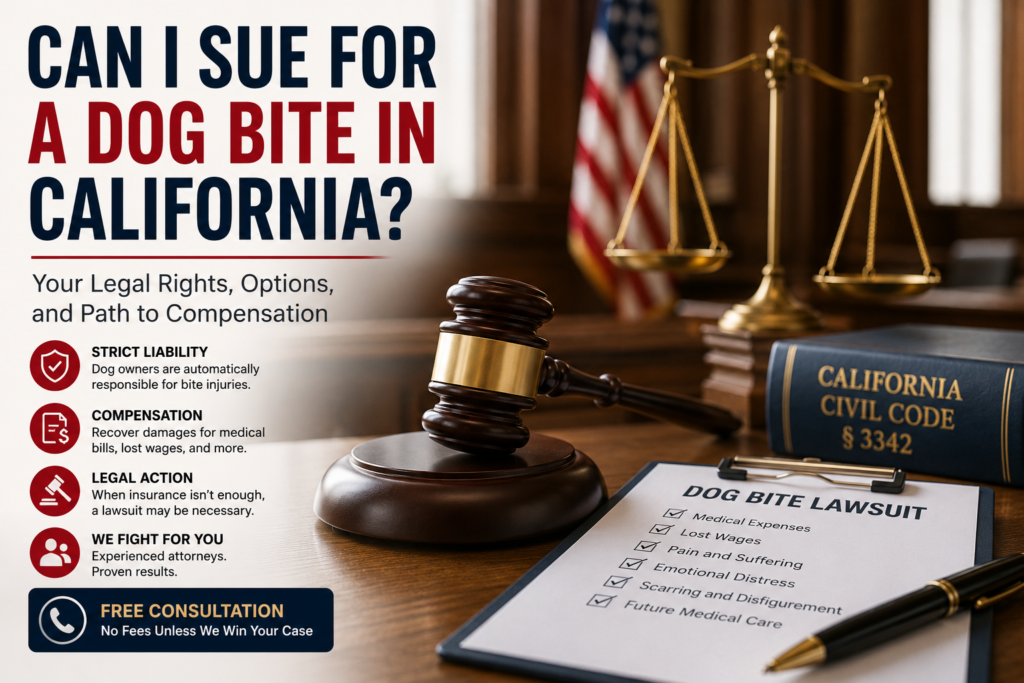
California Civil Code Section 3342 establishes strict liability for dog owners, meaning the owner is automatically responsible for all injuries and consequences flowing from a bite — including permanent scarring. The victim does not need to prove the owner was careless or knew the dog was dangerous. The bite, the resulting scar, and the victim’s lawful presence at the time of the attack are what the law requires. What determines the compensation for that scar is the documented scope of its physical, psychological, and financial impact on the victim’s life.
California imposes no statutory cap on non-economic damages in personal injury cases. This means the non-economic compensation for scarring — pain and suffering from the injury and recovery, emotional distress from permanent disfigurement, loss of enjoyment of life, and embarrassment from visible marks — is not limited by a fixed ceiling. For serious facial scarring cases in particular, this uncapped non-economic recovery is often where the most significant portion of total compensation is found.
Types of Scarring in California Dog Bite Claims
Facial Scars
Facial scarring from a dog bite is the category that produces the highest compensation values in California dog bite cases — and for sound legal and practical reasons. The face is the most socially significant part of the human body. It is the first thing people see. It is the primary medium through which identity, emotion, and personality are communicated. A permanent visible scar on a person’s face affects every interaction they have for the rest of their life — professional encounters, personal relationships, strangers in public, photographs, reflections — in a way that scarring on any other part of the body does not.
Dog bite attacks on children’s faces are particularly severe cases. Children and dogs interact at close range due to their similar heights — and serious facial attacks on young victims produce scars that follow them through the self-conscious years of adolescence, through young adulthood’s professional and social development, and across decades of lived experience. Our child dog bite attorneys work with pediatric plastic surgeons to document both the current state of facial scarring in young victims and the projected future treatment needs over the extended timeline of a child’s remaining life.
Neck and Throat Scars
Scarring on the neck is similarly high-visibility and similarly impactful in terms of its social and professional consequences. Neck scars are not concealable in professional settings, not hidden by standard clothing, and not something victims can routinely avoid confronting in their daily appearance. The psychological impact of a visible neck scar, particularly following a traumatic dog attack, is a significant and fully compensable non-economic damage.
Hand and Arm Scars
Hands and forearms are frequently involved in dog bite injuries — victims instinctively use their hands and arms to protect themselves during an attack, making these areas prime targets for bites that produce serious wounds. Scarring on the hands and arms is highly visible during routine professional and social interactions. For victims whose work involves hand visibility — healthcare workers, attorneys in court, customer service professionals, artists, musicians — scarring in these areas has professional consequences beyond the cosmetic. For victims whose injuries involved the hands, nerve damage often accompanies scarring, adding a functional component to the physical damage picture.
Leg and Body Scars
Scarring on the legs and other body areas carries lower but still meaningful compensation value. These scars affect quality of life, create self-consciousness in social settings involving exposed skin, and may require future treatment depending on the scar’s characteristics. Their compensation value is assessed on the same factors as more visible scars — permanence, severity, extent of treatment required, and psychological impact — but weighted against their lower social visibility compared to facial or hand scarring.
How Is Dog Bite Scar Compensation Calculated in California?
There is no formula that produces a precise dollar amount for scar compensation in a California dog bite claim. What exists is a framework of factors that experienced attorneys, insurance adjusters, and juries apply to determine what fair compensation for a specific scar looks like in the context of a specific victim’s life. Understanding these factors is how victims protect themselves from accepting undervalued early offers.
The most significant factors in California dog bite scar compensation calculations include the location and visibility of the scar — facial scars at the top, progressively lower for decreasing visibility; the size and severity of the scar — larger, more pronounced scars with more impact on appearance carry higher values; the permanence and irreversibility — a scar that will never fully fade and cannot be effectively concealed is worth more than one that will diminish significantly over time; the victim’s age — a 30-year-old with a facial scar will live with its consequences for more decades than a 70-year-old, which affects the compensation calculation; the victim’s occupation and social circumstances — how the scar specifically affects the victim’s professional life and personal relationships; and the availability and cost of future treatment — corrective procedures, laser treatments, or reconstructive surgery that the scar makes medically appropriate are economic damages that add to the total.
California’s pure comparative fault system means that any percentage of fault assigned to the victim reduces total compensation proportionally — which is why insurance companies sometimes attempt comparative fault arguments in scarring cases that would otherwise be straightforward. Understanding and countering these arguments is part of what effective legal representation provides from the earliest stages of a California dog bite claim.
Can Facial Scars Increase the Value of a Dog Bite Claim?
Yes — significantly, and in both economic and non-economic damage categories simultaneously. The economic damages component of a facial scar claim includes all medical costs already incurred for wound treatment and any surgical procedures performed, future plastic surgery or reconstructive procedures that the scar makes medically appropriate, future dermatological treatment and scar management, and any psychological or psychiatric treatment the disfigurement produces. These are documented costs with specific projected values.
The non-economic damages component is where facial scarring has its most pronounced impact on total claim value. California’s uncapped non-economic damages framework allows full compensation for the psychological experience of living with a visible facial scar — the emotional distress, the loss of confidence, the embarrassment in social situations, the impact on relationships, and the permanent reminder of a traumatic event that the scar represents. For serious facial scarring cases, this non-economic component routinely exceeds the economic costs of treatment in total compensation value.
Insurance companies are well aware of this dynamic — which is why facial scar claims are among those most aggressively managed by adjusters and most likely to receive early, inadequate settlement offers before the victim understands the full scope of what their damages are worth. Our guide on average dog bite settlements in California explains why early offers consistently undervalue claims — scarring is among the most undervalued components in these premature offers.
The Psychological Consequences of Permanent Dog Bite Scarring
The psychological impact of permanent scarring following a dog attack is not simply an emotional reaction to a cosmetic change — it is a recognized, clinically documentable consequence that affects mental health, self-perception, and social functioning in ways that California law fully compensates. Understanding the psychological dimension of scar damages is essential to building a claim that captures the full non-economic impact.
Victims with permanent facial or visible scarring from dog bites frequently experience a significant loss of confidence in social and professional settings where their appearance is relevant. Many avoid situations — social gatherings, professional presentations, photographs — that previously caused no anxiety. Some develop clinical depression related to the permanent change in their appearance and the ongoing reminder the scar provides of the attack that produced it. The intersection of physical disfigurement and trauma response means that scarring cases often involve both PTSD from the attack itself and separate psychological consequences from living with the permanent mark the attack left.
For children with facial scarring, the developmental context amplifies these psychological consequences substantially. Adolescence is a period of intense social consciousness about appearance, and a visible facial scar acquired in childhood can profoundly affect a child’s social experience, self-esteem development, and long-term psychological trajectory. These developmental consequences are recognized by California courts and are a legitimate and significant component of non-economic damages in severe dog attack injury claims involving child victims.
What Evidence Helps Prove Scar Compensation Damages?
Building a scar compensation claim that supports its full value requires specific categories of evidence gathered strategically throughout the recovery period. Victims who understand what evidence matters and how to preserve it from the moment of injury significantly strengthen their position in subsequent negotiations.
Photographs taken immediately after the attack — before wound cleaning, before closure, before any medical intervention — capture the injury at its most severe and provide the visual baseline from which all subsequent documentation builds. These pre-treatment photographs are among the most powerful evidence in any scar compensation case and cannot be recreated after the fact. As our detailed guide on evidence for a California dog bite claim explains, immediate photography is one of the most time-sensitive and impactful steps a victim can take.
Serial photographs throughout the healing process — taken at regular intervals from the time of injury through maximum healing — document the wound’s trajectory, the emergence of permanent scarring, and the final appearance of the scar once healing is complete. This photographic series tells the story of the injury’s physical impact in a way that a single image, however dramatic, cannot. Insurance adjusters and juries find the progression from fresh wound to permanent scar compelling evidence that supports non-economic damages claims.
Plastic surgeon or reconstructive specialist evaluation produces professional medical documentation of the scar’s characteristics — its size, depth, texture, color, and prognosis for improvement with or without treatment. A plastic surgeon’s assessment of whether corrective procedures are medically appropriate, what those procedures would involve, and what the projected cost of future treatment would be transforms the future economic damages component of the scarring claim from speculation into a professionally supported figure.
Medical records documenting the original wound and all treatment establish the causal chain from the dog bite to the resulting scar, document the extent of wound management required, and support the economic damages component of the claim. For wounds that required surgical closure, infection management, or multiple treatment stages, the medical record complexity adds to the documented severity picture.
Mental health treatment records documenting psychological consequences of the scarring — depression, anxiety, PTSD, and clinically assessed impact on self-image and social functioning — provide the professional foundation for non-economic damages related to the psychological experience of living with disfigurement, as distinct from the psychological trauma of the attack itself.
Victim journal entries maintained throughout the recovery period provide contemporaneous documentation of how the scarring affects the victim’s daily experience — what situations they now avoid, how they feel when they see the scar, the social interactions that have changed, and the activities they no longer engage in because of self-consciousness. As our article on mistakes that hurt California dog bite claims explains, failing to maintain a journal is one of the most consistently costly evidence gaps in non-economic damage claims.
Witness testimony from family members, close friends, and coworkers who have observed changes in the victim’s behavior, confidence, and social engagement since the attack adds external corroboration to the victim’s account of how the scar has affected their life. These third-party observations are particularly valuable because they come from people without a direct financial stake in the claim’s outcome.
Victims in communities including Downtown San Diego, Chula Vista, and El Cajon benefit from the same expert network and evidence-building approach regardless of where the attack occurred. Our attorneys build this complete evidentiary foundation as a standard part of representing victims with significant scarring damages.
How Insurance Companies Evaluate Scar Claims — And How to Counter It
Insurance adjusters evaluate scarring claims through a systematic minimization lens. Their default approach is to characterize scars as cosmetic rather than functionally significant, to suggest that future treatment will substantially improve appearance, to point to the victim’s age as a factor that reduces the claim’s overall value calculation, and to use social media content showing the victim in public without visible distress as evidence that the psychological impact is limited.
The counter to each of these tactics is professional documentation. A plastic surgeon’s opinion that a scar has limited improvement potential counters the future treatment minimization argument. Clinical mental health records documenting genuine psychological impact counter the adjuster’s social media-based characterization of the victim as unaffected. A comprehensive photographic record showing the evolution of the scar makes cosmetic minimization significantly harder to sustain.
When insurers refuse to offer fair compensation for significant scarring damages, filing a formal dog bite lawsuit in California changes the dynamic. Juries see scarring claims empathetically — particularly facial scarring on children and young victims — and the litigation threat backed by a credible evidence record motivates settlements that pre-litigation negotiations did not produce.
Frequently Asked Questions — Dog Bite Scar Compensation California
Is permanent scarring automatically compensable in a California dog bite claim?
Yes. Permanent scarring resulting from a dog bite is a recognized and compensable category of damages under California law — both as a non-economic damage for its psychological and social impact and as an economic damage for associated future medical costs. The owner’s strict liability under Civil Code Section 3342 extends to all consequences of the bite, including permanent scarring. The question is not whether scarring is compensable but how thoroughly it is documented and how effectively the full scope of its impact is presented in the claim.
Can I recover compensation for future scar revision surgery I haven’t had yet?
Yes. Future medical costs for corrective or reconstructive procedures that are medically appropriate given the nature and location of the scar are recoverable as economic damages — provided they are documented through professional medical opinion, typically from a plastic surgeon, that the procedures are reasonable and medically indicated. These future costs must be included in the demand package before any settlement is finalized, as signing a release extinguishes the right to recover future costs regardless of what procedures become necessary afterward.
Does scar location really affect compensation that much?
Significantly, yes. Facial scarring is consistently valued higher than scarring on less visible body areas because of its constant social visibility and broader life impact. Scarring on the hands, neck, and forearms is also valued higher than scarring concealed by clothing because of its visibility in professional and social contexts. The relevant analysis is always the scar’s actual impact on the specific victim’s life — a visible scar that affects every professional interaction carries more compensable weight than one that is effectively concealed in virtually all daily situations.
What if the scar fades significantly over time?
A scar that is expected to fade substantially with time is valued differently than a permanent, stable scar. However, “fade” rarely means “disappear,” and the trajectory of a scar’s long-term appearance is a medical question — not an insurer’s assumption. A plastic surgeon’s professional assessment of the scar’s prognosis is the appropriate evidence on this question, and it should be obtained before any settlement is finalized. Adjusters who claim a scar will resolve on its own should be countered with medical documentation, not accepted at their word.
My child has a scar on their face from a dog bite. How does this affect the claim?
Child facial scarring cases are among the most significant scar compensation matters in California dog bite law. The longer duration over which the scar will affect the child’s life, the developmental and psychological consequences during formative years, the social impact through adolescence, and the professional and personal effects extending into adulthood all contribute to a damage picture that is substantially larger than a comparable injury to an adult victim. California law protects minor victims through tolled statutes of limitations and a favorable standard for evaluating their conduct — but early engagement of an attorney and a plastic surgeon is essential to building the complete case these claims require.
Protect the Full Value of Your Scar Compensation Claim
Permanent scarring from a dog bite is not a cosmetic afterthought in a California personal injury claim — it is a substantive legal damages category that, when properly documented and professionally advocated, can represent a significant portion of total compensation. The difference between a well-documented scar claim and an underdocumented one is the difference between an insurer paying full value and an insurer offering a fraction of what the law entitles you to recover.
Our team at dogbitelawyersandiego.com represents dog bite victims with scarring claims throughout San Diego County. A completely free case evaluation is available now — 24 hours a day, no upfront fees, and no attorney costs unless we recover compensation for you. If a dog attack left you or your child with permanent scarring, call us today to understand what your claim is actually worth.