How Long Do You Have to File a Dog Bite Claim in California? Time is not on your side after a dog bite — and not for the reason most people assume. Yes, dog bite wounds can worsen quickly, and yes, infections can develop within hours. But the legal clock that starts ticking the moment a dog attacks you in California may ultimately matter just as much as your medical treatment. Miss the legal deadline, and it does not matter how clear the liability is, how severe your injuries are, or how cooperative the insurance company seemed at first. Your right to compensation is gone.
California law sets firm deadlines for filing a dog bite claim, and understanding those deadlines — along with the exceptions that apply in certain circumstances — is essential for every dog bite victim in this state. This article explains the statute of limitations for California dog bite claims, the exceptions that can extend or shorten your window, what happens if you miss the deadline, and why contacting a California dog bite attorney early gives your case the strongest possible foundation.
If you are following our California dog bite legal series, this article builds on our earlier guides covering what happens after a dog bite in California, who pays for dog bite injuries, and what your settlement may be worth. Understanding the deadline to file is the piece that determines whether everything else in this series is relevant to your situation at all.
California’s Statute of Limitations for Dog Bite Claims
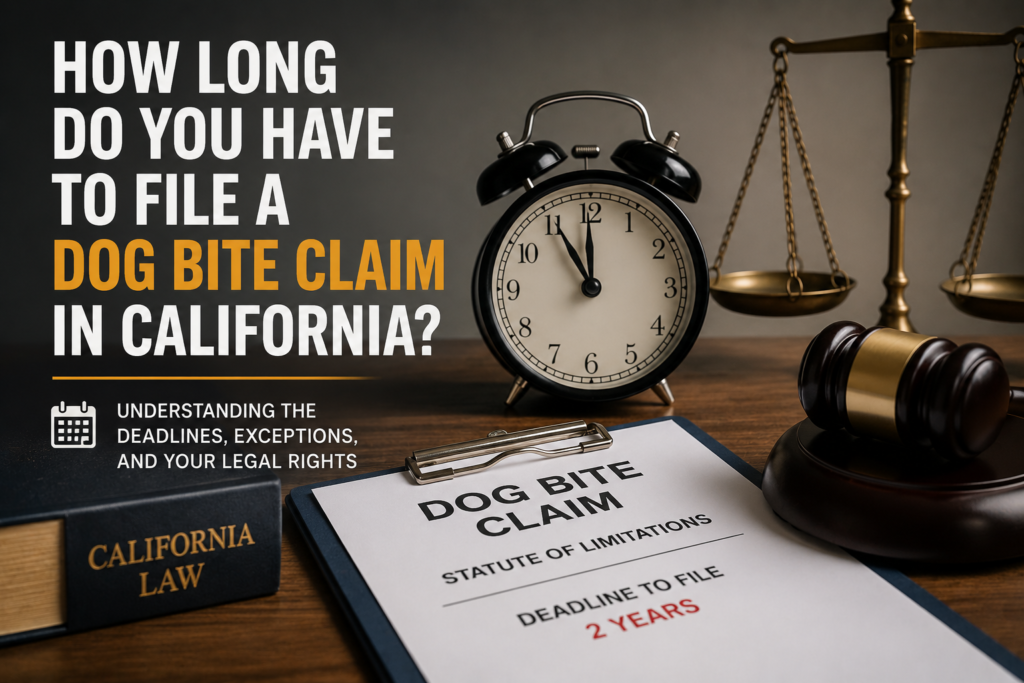
California’s statute of limitations for dog bite injury claims is established under California Code of Civil Procedure Section 335.1, which sets a two-year deadline for personal injury lawsuits. For dog bite claims specifically, this two-year clock generally begins on the date the bite occurred.
What this means in practical terms is that if you were bitten by a dog on any given date in California, you have two years from that date to file a formal civil lawsuit against the responsible party. If the two-year period passes without a lawsuit being filed, California courts will almost certainly dismiss the case — not on its merits, but solely on the basis that the filing deadline was missed. The strength of your evidence, the severity of your injuries, and the clarity of the dog owner’s liability under California Civil Code Section 3342 become entirely irrelevant at that point.
It is important to distinguish between an insurance claim and a civil lawsuit. You can file an insurance claim against the dog owner’s homeowner’s or renter’s policy at any point, and insurers are not bound by the statute of limitations the way courts are. However, the practical reality is that your leverage in insurance negotiations is directly tied to your ability to sue. Once the two-year window closes, you lose the ability to file a lawsuit — and with it, the credible threat of litigation that motivates insurance companies to settle fairly. Attorneys who handle dog bite claims in San Diego and throughout California consistently advise clients to treat the two-year window as the outer boundary, not a comfortable horizon.
The Critical Exception — When the Victim Is a Minor
California law provides an important protection for child dog bite victims through a legal doctrine called tolling. When the person bitten by a dog is a minor — under the age of 18 — the two-year statute of limitations does not begin running at the time of the attack. Instead, it is tolled, meaning paused, until the child reaches the age of 18. At that point, the two-year clock begins, giving the now-adult victim until their twentieth birthday to file a lawsuit.
This exception exists because California law recognizes that children cannot protect their own legal rights and should not have those rights extinguished simply because their parents or guardians did not act within two years of the attack. Dog bites that occur in childhood — and that may cause permanent scarring, disfigurement, or psychological consequences that follow the child into adulthood — deserve a legal remedy that the child can pursue when they reach legal maturity.
However, the tolling of the statute of limitations for minors does not mean that families should wait. The practical problems created by delay remain fully present regardless of the legal deadline. Evidence degrades. Witnesses become difficult to locate. Animal control records become harder to access. Insurance policies may lapse. The dog owner may move, change insurers, or alter their financial circumstances. A parent or guardian who acts promptly after a child is bitten by a dog — consulting an attorney, preserving evidence, and documenting injuries thoroughly — gives the case a foundation that waiting fifteen or seventeen years to file simply cannot replicate.
The Government Claims Deadline — A Shorter and Stricter Window
California’s two-year statute of limitations applies to lawsuits against private individuals and entities. When a dog bite occurs on government property or involves a government-owned animal — a dog belonging to a law enforcement agency, an attack that occurs at a city park where government negligence contributed to the incident, or a bite involving an animal control officer’s dog — an entirely different and much shorter deadline applies.
Under the California Government Claims Act, a victim who intends to sue a government entity must first file an administrative tort claim directly with that agency within six months of the incident. Missing this six-month deadline generally bars the right to file a subsequent lawsuit against the government entity permanently, with very limited exceptions.
This is a deadline that catches victims off guard more than any other in California personal injury law. Six months can pass quickly — particularly when a victim is still in active medical treatment, dealing with insurance paperwork, and managing the practical disruptions caused by the injury. If your dog bite occurred in a city-owned park, near a government facility, or involved any government agency’s animal, treating the six-month mark as your personal deadline for consulting an attorney is not an overreaction. It is a necessary precaution.
Other Circumstances That Can Affect Your Filing Deadline
Discovery of Injuries
In standard dog bite cases, the two-year clock runs from the date of the attack because the injury is immediately apparent. However, California courts recognize a discovery rule in some circumstances — the statute of limitations begins when the plaintiff knew or reasonably should have known about the injury and its cause. For most dog bite cases, this distinction does not change the analysis because the bite and the injury are simultaneous and obvious. In rare cases where complications were not immediately apparent — a serious infection that developed days later, or psychological symptoms that emerged weeks after what initially seemed like a minor incident — the discovery rule may provide some flexibility. An attorney can advise on whether this exception applies to your specific situation.
Legal Incapacity
If a dog bite victim was legally incapacitated at the time of the attack — due to a mental disability or condition that affects legal capacity — California law may toll the statute of limitations during the period of incapacity. This exception is narrowly applied and requires specific circumstances. It is not available simply because a victim was severely injured or emotionally traumatized by the attack.
Defendant’s Absence from California
If the dog owner leaves California after the bite occurs and before the lawsuit can be filed, California law may toll the statute of limitations during the period the defendant is absent from the state. This prevents a defendant from effectively extinguishing a victim’s claim simply by relocating outside California’s jurisdiction.
What Happens If You Miss the Dog Bite Claim Deadline in California
Missing the statute of limitations on a California dog attack claim is not a procedural technicality that courts work around — it is a permanent and essentially irreversible bar to recovery. If you file a lawsuit after the two-year deadline has passed and the defendant raises the statute of limitations as a defense, the court will dismiss your case regardless of how compelling your evidence is.
The dog owner could have clearly been at fault. The injuries could be serious and well-documented. The insurance company could have been conducting settlement negotiations right up to the deadline. None of that matters. Once the filing window closes and no recognized exception applies, the legal right to compensation through the courts is extinguished.
This reality underscores something attorneys who handle California dog bite lawsuits emphasize consistently: the statute of limitations is not a warning to file eventually — it is a hard deadline with consequences that no amount of compelling facts can overcome after the fact. Insurance companies sometimes exploit the statute of limitations deliberately. An adjuster who has been engaged in ongoing negotiations, asking for additional documentation, and expressing apparent willingness to settle may simply be running out the clock. Victims who have not tracked the deadline and have not retained an attorney can find themselves in the position of having exhausted their legal options while believing the process was still moving forward.
Why Acting Early Matters Beyond the Legal Deadline
Even with a two-year window, the practical benefits of acting promptly after a California dog bite are substantial and well-documented. Early action preserves evidence, maintains access to witnesses, and creates a stronger legal foundation regardless of the applicable deadline.
Evidence Preservation
Surveillance footage from businesses, parks, and residential security systems is often overwritten within 30 to 90 days. Photographs taken immediately after the attack cannot be replicated later. The physical condition of the attack location — a broken fence, an unsecured gate, a missing warning sign — can change. Animal control records remain most accessible shortly after a reported incident. Every day that passes after a dog bite makes the evidentiary picture less complete.
Medical Documentation
Consistent, uninterrupted medical treatment beginning immediately after the attack creates the documented chronology that supports your damages claim. Gaps in treatment — periods where a victim did not seek care due to financial pressure, time constraints, or a belief that the injury was healing — are used by insurance companies to argue that the injuries were less serious than claimed. An attorney retained early can advise on treatment continuity as part of case strategy, not just as a health recommendation.
Insurance Company Tactics
Insurance companies that handle dog bite settlements in California routinely attempt to engage unrepresented victims in ongoing conversations designed to manage the claim to the insurer’s advantage. Early recorded statements, requests for medical authorizations that give the insurer broader access than necessary, and low early offers extended before the victim understands the full value of their claim are all standard tools. An attorney involved from the beginning protects against each of these tactics while actively building the evidence picture that supports maximum recovery.
Common Scenarios — How the Deadline Plays Out in Real Cases
The Neighbor’s Dog Scenario
A victim is bitten by a neighbor’s dog and believes a friendly resolution is possible. The neighbor promises to cover medical bills. Months pass. The neighbor stops responding. The victim contacts an attorney fourteen months after the bite, still within the two-year window but with degraded evidence and a more difficult factual record to reconstruct. Early attorney involvement — even when a neighborly resolution seemed likely — would have preserved options and evidence throughout.
The Insurance Negotiation Delay
A victim retains an attorney, files a claim with the dog owner’s insurer, and enters extended negotiations. The case is not resolved before the two-year mark, but the attorney has already filed a lawsuit as a protective measure — a common practice to toll the statute of limitations while negotiations continue. Victims who do not retain attorneys sometimes allow the filing window to close during negotiations, unaware that the lawsuit deadline operates independently of the insurance claim process.
The Park Attack and Government Property Deadline
A victim is attacked near a public park in San Diego where a maintenance failure by the city contributed to the incident. The victim, focused on recovering from injuries, does not consult an attorney until seven months after the attack. The six-month government claims deadline has already passed, eliminating the city as a defendant in any subsequent litigation. Early attorney consultation would have identified the government entity deadline and preserved that avenue of recovery.
Frequently Asked Questions — Dog Bite Claim Deadlines in California
Does the two-year deadline apply if I was only filing an insurance claim, not a lawsuit?
The two-year statute of limitations technically governs the right to file a lawsuit, not an insurance claim. However, your leverage in insurance negotiations is directly tied to your ability to sue. Once the filing deadline passes, insurance companies have significantly less motivation to settle fairly because the litigation threat — the primary driver of fair settlement outcomes — no longer exists. Treating the two-year mark as the deadline for the entire claims process, not just the formal lawsuit, is the practical approach.
What if I did not realize how serious my injuries were until months after the bite?
California’s discovery rule may provide some relief in cases where the injury’s seriousness was not reasonably apparent at the time of the attack. For most dog bites, this exception does not apply because the injury is immediately obvious. For cases involving complications that emerged significantly later — a serious infection with lasting consequences, or psychological symptoms that developed weeks after the incident — an attorney should evaluate whether the discovery rule affects the applicable deadline in your specific case.
My child was bitten by a dog three years ago. Have we missed the deadline to sue?
For minor victims in California, the statute of limitations is tolled until the child turns 18. If your child was bitten before turning 18, the two-year filing window generally does not begin until their eighteenth birthday. That said, early consultation with an attorney is strongly advisable even for minor victims — evidence that existed at the time of the attack may no longer be available years later, and the strength of any future claim depends on documentation gathered promptly after the incident.
I was bitten by a dog at a government facility. How is my deadline different?
If a government entity bears any responsibility for the dog bite — whether as the owner of the animal or through negligent maintenance of a public space that contributed to the attack — the California Government Claims Act requires you to file an administrative claim with that agency within six months of the incident. Missing this six-month deadline typically bars any subsequent lawsuit against the government entity. Contact a California dog bite attorney immediately if you believe a government agency may share responsibility for your injuries.
Can I still recover compensation if I missed the statute of limitations?
If the statute of limitations has expired and no applicable exception or tolling provision applies, recovering compensation through the courts is generally not possible. In limited circumstances — where the defendant actively concealed relevant information, or where a recognized tolling provision applies — there may be arguments for extending the deadline. These are narrow exceptions that require careful legal analysis. The honest answer is that missing the filing deadline is a serious and usually permanent bar to recovery, which is precisely why early action and early attorney consultation matter so much.
Conclusion — The Deadline Is Real. Early Action Is the Answer.
California’s two-year statute of limitations for dog bite injury claims is not a formality. It is a firm legal boundary that permanently closes the door to court-based compensation when it passes. For victims bitten on government property, a six-month administrative deadline may apply — even shorter and with consequences just as permanent.
Understanding these deadlines is essential, but understanding them is not enough on its own. The practical work of building a strong California dog attack claim — preserving evidence, documenting injuries thoroughly, identifying all sources of insurance coverage, and protecting yourself from insurance company tactics designed to exploit uninformed victims — all of it is most effectively done as early as possible after the attack, not in the weeks before the deadline expires.
If a dog bit you or a family member in California — whether in Downtown San Diego, Chula Vista, El Cajon, or anywhere else in San Diego County — a free case evaluation with our attorneys is available right now, at no cost and with no obligation. We will review your specific circumstances, identify all applicable deadlines, and give you a clear picture of your legal options before time becomes an issue rather than after. Visit dogbitelawyersandiego.com or explore additional California dog bite legal resources at our legal resource blog.