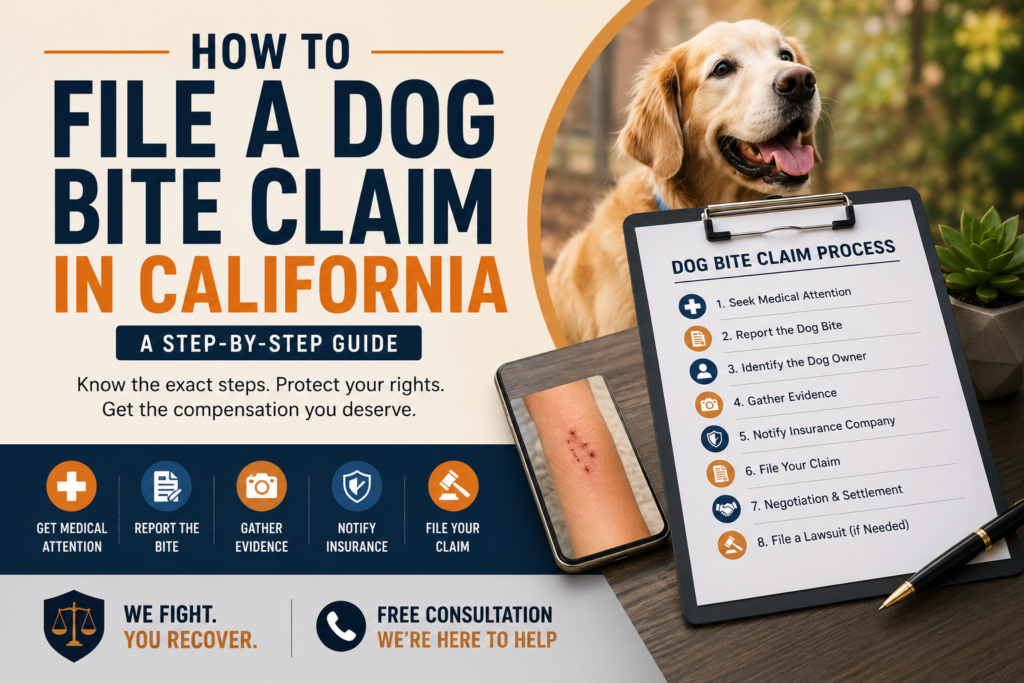
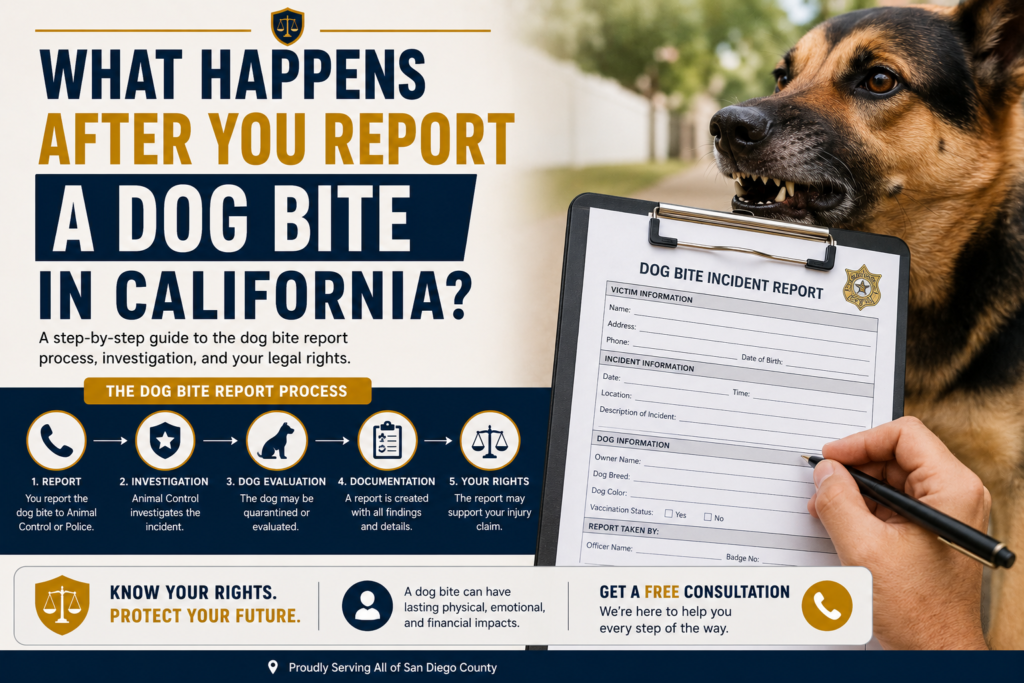
Most people think of a dog bite as something that happens on a walk through the neighborhood or at a friend’s house. But a significant number of dog attacks happen on the job, and when they do, the legal situation is more layered than a standard bite claim. If you suffered a dog bite while working in California, you may be entitled to pursue two separate sources of compensation at the same time, and most injured workers don’t know that when they file their initial workers’ comp claim.
Who Gets Bitten by Dogs While Working?
Dog bites are an occupational hazard for more workers than most people realize. Any job that regularly involves entering private property or interacting with animals creates genuine bite risk, and certain occupations face it almost daily.
The workers most commonly bitten on the job in California include:
- Mail carriers and delivery drivers, who enter yards and approach front doors constantly, often without warning to the household dog inside.
- Utility workers, including meter readers, gas technicians, and electrical crews, who need access to backyards and side yards where dogs are often left unsupervised.
- Landscapers and gardeners, who work in residential yards and frequently encounter dogs that owners assume are “friendly.”
- Home healthcare workers and in-home service providers, who enter private residences where dogs roam freely.
- Pest control technicians, who regularly inspect areas of homes where dogs are kept.
- Cable and internet technicians, plumbers, HVAC workers, and other tradespeople who enter private property as a routine part of their work.
- Animal shelter and veterinary workers, who handle dogs with unknown temperaments and backgrounds.
- Dog groomers and pet sitters, who work directly with animals, sometimes without accurate information about the animal’s history.
- Real estate agents and inspectors, who enter homes where owners may have left pets inside.
What all of these workers have in common is that their jobs require them to be in places where dogs are present, and California law treats every one of them as a lawfully present person entitled to full legal protection.
Dog Bite While Working in California: Your Two Separate Legal Claims
Here’s the part most workers miss, sometimes because their employer’s HR department steers them toward workers’ comp and leaves out the rest.
When you’re bitten by a dog while working in California, you typically have two distinct legal claims, and California law specifically preserves your right to pursue both at the same time.
Claim One: Workers’ Compensation
Workers’ compensation is a no-fault system. If you were injured during the course and scope of your job duties, you’re generally entitled to benefits regardless of who was at fault for the attack. You don’t need to prove the dog owner was negligent. You don’t need to prove your employer did anything wrong. You just need to show the injury happened while you were working.
Workers’ comp typically covers:
- All medical treatment related to the bite injury, with no deductibles or co-pays
- Temporary disability payments, generally two-thirds of your average weekly pre-tax wages up to a state-set maximum, while you’re unable to work during recovery
- Permanent disability benefits if the injury results in lasting impairment
- Vocational rehabilitation if injuries prevent you from returning to your previous work
You must report the injury to your employer within 30 days under California law, though sooner is always better. Your employer should provide a DWC-1 claim form, which is what formally opens the workers’ comp process.
Workers’ comp sounds comprehensive, and for some injuries it is. But it has real limits, and those limits matter a great deal in dog bite cases.
What Workers’ Comp Doesn’t Cover
Workers’ compensation does not pay for pain and suffering. It does not cover the full value of lost future earnings for serious injuries. The disability payment of roughly two-thirds of wages leaves a gap that many injured workers don’t think about until they’re actually living it. And workers’ comp doesn’t compensate for the long-term emotional and psychological impact of a traumatic attack.
These are exactly the categories that a civil lawsuit against the dog’s owner covers, which is why pursuing both claims simultaneously is almost always the right approach for anyone seriously injured on the job.
Claim Two: Civil Lawsuit Against the Dog’s Owner Under California Strict Liability
Entirely separate from workers’ comp, you have a direct civil claim against the dog’s owner under California Civil Code Section 3342. This statute makes dog owners strictly liable for injuries their dogs cause to people who are lawfully on private property or in public spaces. Being there to do your job makes you lawfully present, full stop, even if the owner didn’t specifically invite you that day.
Strict liability means you don’t have to prove the owner was negligent or that the dog had ever bitten anyone before. The owner is liable because their dog bit you while you were doing your job. The evidence you need is that the bite happened and that you were there lawfully.
A civil claim against the dog’s owner can recover:
- The full value of medical expenses, including costs workers’ comp doesn’t reimburse
- The remaining one-third of lost wages not covered by temporary disability payments
- Future lost income and earning capacity if injuries are lasting
- Pain and suffering
- Emotional distress and psychological trauma
- Permanent scarring and disfigurement
- Future medical treatment, including reconstructive surgery and therapy
California Labor Code Section 3852 explicitly preserves this right. Your workers’ comp claim does not eliminate or reduce your civil claim against the dog’s owner. Both claims proceed independently, and you are entitled to pursue them simultaneously. This is something insurance companies representing dog owners do not volunteer when they call you.
How Workers’ Comp and the Civil Claim Interact: The Lien Issue
There is one significant complication that anyone pursuing both claims needs to understand upfront: the workers’ comp lien.
When your employer’s workers’ comp insurer pays your medical bills and temporary disability payments, California law gives them the right to recover a portion of what they paid from your civil settlement or judgment. This is called subrogation, and it’s governed by Labor Code Sections 3852 through 3860. It doesn’t eliminate your right to the civil claim, but it does mean the workers’ comp insurer has a lien on your civil recovery for the benefits they paid out.
What this means in practice is that when your civil case settles, the workers’ comp lien needs to be addressed before you see the full recovery in your pocket. Critically, though, the lien is often negotiable. Under Labor Code Section 3856, the lien is reduced by the insurer’s proportional share of your attorney fees and costs. And in cases where an attorney can demonstrate that the employer’s own negligence contributed to the conditions that allowed the attack to happen, there may be grounds to further reduce the lien.
None of this should discourage you from pursuing both claims. A well-handled case that coordinates workers’ comp and civil recovery almost always results in significantly more total compensation than workers’ comp alone, even after the lien is resolved. But it requires careful management from day one, which is exactly why getting legal advice early matters so much in these cases.
What Workers Are Protected? Independent Contractors vs. Employees
Workers’ compensation in California applies to employees, not independent contractors in most circumstances. If you’re a gig worker, a freelance tradesperson, or someone classified as an independent contractor, your employer’s workers’ comp policy may not cover you. This distinction affects which path of recovery is available.
The good news is that the civil claim against the dog’s owner under Civil Code 3342 applies to everyone, employee or independent contractor. If you were lawfully on that property doing your job, the dog owner’s strict liability exists regardless of your employment classification. For independent contractors, the civil claim is often the only avenue, which makes it more critical, not less, and makes strict liability under 3342 particularly valuable.
There’s also a nuance around workers who are placed by staffing agencies or who work at locations controlled by a different entity than their formal employer. These dual employment situations can raise complex questions about who qualifies as a third party for purposes of the civil claim. An attorney familiar with these scenarios can evaluate the structure quickly and identify all available sources of recovery.
California Strict Liability and the “Lawfully Present” Standard for Workers
The phrase “lawfully present” in Civil Code Section 3342 is what protects workers on private property. Courts have interpreted this broadly and consistently in favor of workers whose job requires them to be somewhere.
A mail carrier approaching a front door is lawfully present. A gas technician entering a backyard to read a meter is lawfully present. A landscaper working in a yard is lawfully present. An HVAC technician sent to a home for repairs is lawfully present. None of these workers need a personal invitation from the homeowner or a specific warning about the dog before the law’s protection kicks in. The job duty itself establishes the right to be there.
What does not apply to most working situations is the provocation defense. The narrow circumstances where an owner might argue a bite victim provoked the dog are harder to apply to a worker who is simply doing their job. A meter reader who walks through a gate to access a utility area is not provoking a dog, even if the dog charges the moment the gate opens.
What Evidence Matters Most in a Dog Bite While Working in California Case
Evidence preservation after a work-related dog bite needs to happen on two tracks simultaneously: one for workers’ comp and one for the civil claim. They overlap but aren’t identical.
Report the Injury Immediately
Tell your supervisor about the attack the same day it happens. File a written incident report. Request the DWC-1 claim form from your employer. The 30-day reporting requirement under California workers’ comp law is a firm deadline, and failing to meet it can jeopardize your benefits. Acting the same day eliminates any dispute about when or whether the employer was notified.
Get Medical Care and Keep Records
Seek medical treatment as soon as possible after reporting the incident. This establishes the connection between the attack and your injuries through dated medical records. Keep every bill, every pharmacy receipt, every after-visit summary, and every piece of documentation related to your treatment. Our article on dog bite medical bill compensation California explains what categories of medical costs are recoverable in a civil claim and how to document them properly.
Document the Scene and the Attack
Photograph your injuries before and after treatment. Take photos of the location where the attack occurred, including any open gates, unfenced areas, or conditions that allowed the dog to access you. Get the dog owner’s name and contact information, and find out whether they have homeowners or renters insurance. Contact information from any witnesses, including coworkers who were present, needs to be collected before people disperse.
Report to Animal Control
File a report with animal control or the local humane enforcement department. This creates an official record, triggers an investigation, and may reveal prior incidents involving the same dog, which can strengthen the civil claim even though strict liability doesn’t require proof of prior biting.
Don’t Give a Recorded Statement to the Dog Owner’s Insurer Without Counsel
The homeowner’s or renter’s insurer representing the dog’s owner will want a recorded statement. Their goal in taking it is not to help you. Adjusters are trained to ask questions designed to establish that you somehow contributed to the incident, entered an area you weren’t supposed to, or interacted with the dog in a way that could be characterized as provocation. Speak with an attorney before giving any statement to the owner’s insurer.
Common Mistakes That Hurt Work-Related Dog Bite Claims
These mistakes show up consistently in cases where injured workers end up with less compensation than they were entitled to.
- Only filing workers’ comp and not pursuing the civil claim. This is the biggest one. Workers’ comp alone doesn’t cover pain and suffering, full lost wages, or long-term scarring. The civil claim against the dog’s owner exists specifically to fill those gaps.
- Settling the civil claim without addressing the workers’ comp lien. Settling without properly accounting for the lien can result in money flowing back to the insurer that could have been negotiated down significantly.
- Missing the 30-day workers’ comp reporting window. Late reporting creates disputes about whether the injury actually happened at work, and can give the employer grounds to challenge the claim.
- Assuming the dog owner has no coverage. Most homeowners and renters policies include dog bite liability coverage. Assuming otherwise without investigating means potentially walking away from available compensation.
- Accepting an early settlement from the owner’s insurer before the full injury picture is known. Scarring, nerve damage, and psychological effects often develop over weeks and months. Settling while the full extent of injuries is still unclear locks in a number that almost certainly doesn’t reflect the true value of the claim.
Our article on who pays for a dog bite injury in California covers how insurance coverage typically applies and where to look when it isn’t immediately obvious.
Specific Work Situations and How They Affect Your Claim
You Were Bitten at a Customer’s Home While On Duty
This is the most common scenario, and both claims are typically straightforward. Workers’ comp applies because you were on the job. The civil claim against the homeowner applies because you were lawfully present performing your duties. The lien management issue applies when both claims are active simultaneously.
A Coworker’s Dog Bit You at the Workplace
This raises different questions. If the dog belongs to a coworker and the employer permitted the dog at the workplace, the civil claim may be complicated by the exclusive remedy provisions of workers’ comp, which generally bar lawsuits against employers. However, there are exceptions, including when an employer brings a dog onto the premises for purely personal reasons unrelated to the business, which courts have recognized as the “dual capacity” doctrine. These situations require careful legal analysis specific to the facts.
You Are a Self-Employed Contractor or Gig Worker
Without employer workers’ comp coverage, your entire recovery depends on the civil claim against the dog’s owner. California’s strict liability standard works entirely in your favor here. You don’t need to prove negligence, only that you were lawfully present and the dog bit you. An attorney can also investigate whether any other coverage, such as a business liability policy or umbrella policy held by the homeowner, may apply.
Dog Bite While Working in California: What Full Compensation Actually Looks Like
The combined recovery available through workers’ comp and a civil claim against the dog’s owner is more comprehensive than either avenue alone. Workers’ comp handles the medical coverage and wage replacement while the civil claim fills in everything workers’ comp excludes, including pain and suffering, psychological harm, full lost wages, and future medical costs.
For workers who sustain serious injuries, including lacerations requiring surgery, scarring, nerve damage, or documented psychological trauma, the civil claim often represents the majority of the total financial recovery. Our articles on pain and suffering compensation in dog bite cases and what happens after a dog bite in California explain how these damages are calculated and documented.
For cases involving severe injuries, our severe dog attack injuries page covers how catastrophic and permanent injuries affect the overall value of both claims. And for workers in specific parts of San Diego County, our local pages for Downtown San Diego, Chula Vista, and El Cajon are useful starting points for understanding how these cases are handled locally.
Frequently Asked Questions
Can I sue the dog owner if I’m already getting workers’ comp for a dog bite while working in California?
Yes. California Labor Code Section 3852 explicitly preserves your right to pursue a civil claim against the dog’s owner simultaneously with your workers’ comp claim. Workers’ comp is your remedy against your employer. The civil claim is a separate action against the third party, the dog owner, whose animal caused your injury. The workers’ comp insurer will assert a lien on your civil recovery for benefits paid, but that lien is typically negotiable and doesn’t eliminate the value of pursuing both claims.
What if the dog owner says I provoked the dog?
The provocation defense has a high bar under California law, particularly for workers performing job duties. A worker accessing a meter, delivering a package, or entering a property for a scheduled service call is not provoking an animal, even if the dog reacts aggressively. Documented work orders, GPS records, and employer dispatch logs help establish that you were exactly where your job required you to be.
Does it matter that the dog had never bitten anyone before?
Not for the civil claim. California’s strict liability standard under Civil Code 3342 applies regardless of the dog’s history. The owner is liable because the bite happened while you were lawfully present, full stop.
What if I’m an independent contractor, not an employee?
Workers’ comp may not cover you as an independent contractor, but your civil claim against the dog’s owner is entirely intact. Strict liability applies to anyone lawfully on the property, regardless of employment status. For self-employed workers, the civil claim is the primary, and sometimes only, avenue of recovery.
How long do I have to file a civil claim after a dog bite at work?
Generally two years from the date of the bite for a civil claim against the dog’s owner. If a government entity is involved, the timeline is significantly shorter. Workers’ comp claims have their own separate deadlines. Consulting an attorney early keeps all options open.
Will my employer retaliate if I file a workers’ comp claim?
Retaliating against an employee for filing a workers’ comp claim is illegal in California. If you experience adverse treatment after filing, that’s a separate legal issue your attorney should know about immediately.
What’s the first thing I should do after a dog bite at work?
Report the injury to your supervisor the same day, get medical care as soon as possible, photograph your injuries and the scene, collect the dog owner’s information, report the attack to animal control, and contact an attorney before giving any recorded statement to the dog owner’s insurer.
You Were Doing Your Job. The Dog’s Owner Is Responsible for What Happened Next.
A dog bite while working in California is not just a workers’ comp matter, and settling it as one almost always leaves compensation on the table. California law gives injured workers two separate paths to recovery, and the civil claim against the dog’s owner, covering pain and suffering, full lost wages, and long-term medical costs, is often the more valuable of the two.
Understanding how to coordinate both claims, manage the workers’ comp lien, and build a complete picture of your damages requires legal experience with exactly this kind of case. That’s what we do for workers throughout San Diego County who were bitten on the job and weren’t sure what their options were.
Schedule a free dog bite consultation today. There’s no fee unless we recover compensation for you, and no obligation to find out exactly where your case stands and what both claims are worth.
Visit the Dog Bite Lawyers San Diego homepage to learn more about how we help injured workers and dog bite victims throughout San Diego County recover the full compensation California law entitles them to.