How much is a dog bite claim worth in California is one of the most common — and most honestly unanswerable — questions a dog bite attorney hears. The unanswerable part is not evasion. It is accuracy. No two dog bite claims produce the same value because no two attacks produce identical injuries, identical financial losses, identical insurance coverage, or identical evidentiary records. A claim involving minor puncture wounds that healed cleanly in two weeks and a claim involving facial reconstruction surgery following a severe attack are both California dog bite claims — but their values are not remotely comparable.
What experienced California dog bite attorneys can tell you with precision is this: the value of a dog bite claim is determined by a specific set of factors, each of which can be documented, developed, and maximized through professional legal representation. Understanding those factors — and understanding what inflates or deflates them — is how victims approach the claims process with realistic expectations and the knowledge to protect what their case is actually worth.
This article is the practical companion to our earlier guide on average dog bite settlements in California. Where that article explains why averages are misleading, this one breaks down exactly what drives value in an individual California dog bite claim.
How Much Is a Dog Bite Claim Worth in California — The Framework
California law allows dog bite victims to recover two categories of compensatory damages: economic damages, which are measurable financial losses the attack caused, and non-economic damages, which represent the human cost of the injury beyond what bills and pay stubs capture. The total value of a California dog bite claim is the sum of everything properly documented and legally supported within both categories — subject to the practical ceiling imposed by available insurance coverage and, when that coverage is insufficient, by the dog owner’s personal financial capacity.
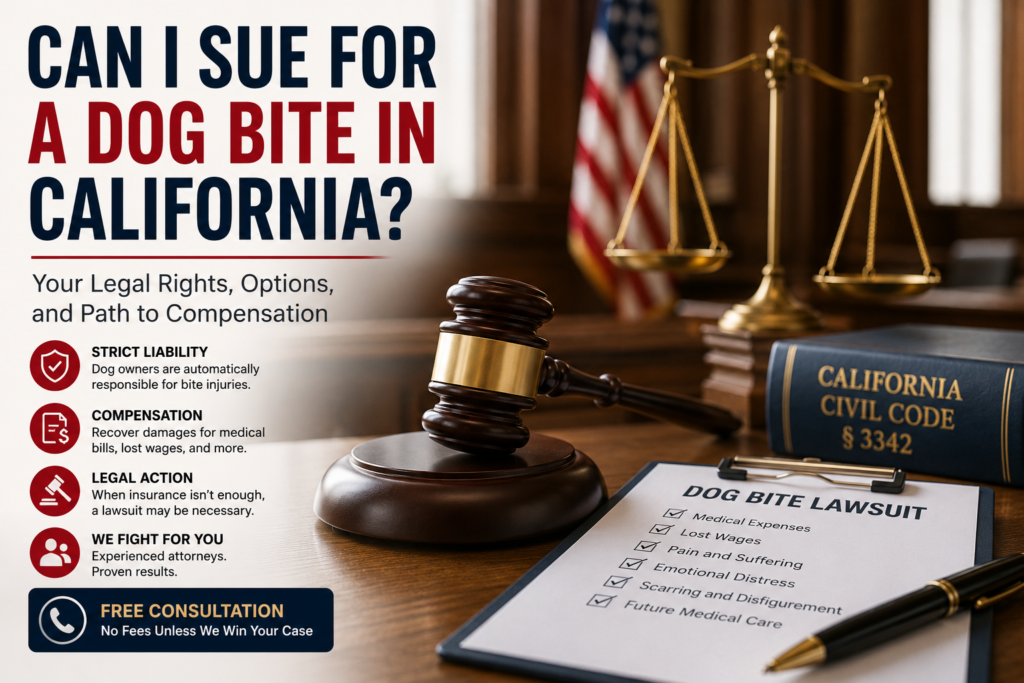
Under California Civil Code Section 3342, as covered in our comprehensive guide on California dog bite law, owners are strictly liable for bite injuries. That liability establishes who is responsible. The documented damages establish how much they owe. The gap between what an insurer initially offers and what a claim is actually worth is almost always a documentation and advocacy gap — not a legal gap.
The Factors That Determine the Value of a California Dog Bite Claim
Severity and Nature of the Physical Injuries
The single most significant driver of California dog bite claim value is the nature and severity of the physical injuries. This is not simply about the size of the wound — it is about the category of harm, the medical complexity of treatment, and the permanence of the consequences.
A bite that required emergency cleaning, a course of antibiotics, and a few follow-up visits produces a different baseline than a bite that required emergency surgery, hospitalization, wound revision, nerve repair, and an extended course of physical therapy. Bites involving the face, hands, or joints — areas where the functional and cosmetic consequences of injury are most pronounced and most lasting — carry higher values than bites to areas of the body where healing is less complicated and the long-term impact is more contained.
The injury categories that most consistently produce the highest claim values in California dog bite cases include: deep lacerations requiring surgical closure, injuries producing permanent nerve damage or sensory loss, attacks resulting in broken bones, bites that become seriously infected requiring hospitalization or IV antibiotics, and injuries to the face or hands. Our attorneys who handle severe dog attack injuries regularly work with medical experts to fully document the complexity and long-term significance of these injuries in claim preparation.
Medical Expenses — Past and Future
Every dollar spent on medical treatment directly attributable to the dog bite is a recoverable economic damage. This includes emergency department costs, ambulance transport if applicable, imaging studies, wound care, surgical procedures, specialist consultations, physical or occupational therapy, prescription medications, and any scar revision or reconstructive procedures already performed.
Future medical costs are equally recoverable — and equally important to document accurately before any settlement is finalized. As our guide on mistakes that hurt California dog bite claims explains, settling before maximum medical improvement means permanently forfeiting the right to recover future costs that were not yet projectable at the time of settlement. Future care plans produced by treating physicians — covering additional surgeries, long-term psychological treatment, and specialist follow-up — are essential to ensuring the total medical cost component of a California dog bite claim reflects the full financial reality of the injuries.
Lost Income and Reduced Earning Capacity
All documented wage loss attributable to the dog bite — time missed from work for hospitalization, recovery, medical appointments, and treatment — is recoverable as economic damages. This requires documentation: pay records, employer statements confirming the missed work and the compensation rate, and evidence connecting the specific days missed to the injury and its treatment.
For serious injuries that produce lasting functional limitations, future lost earning capacity becomes a separate and often substantial component of the claim. When permanent nerve damage limits hand function, when chronic pain prevents return to a physically demanding occupation, or when psychological consequences affect work performance indefinitely, a vocational expert’s analysis of the impact on future earnings adds documented economic value that goes far beyond the medical bills already accumulated. In San Diego dog bite claims involving working-age victims with physically demanding occupations, this component can significantly influence total claim value.
Pain and Suffering
California imposes no cap on pain and suffering damages in personal injury cases, which makes this component particularly significant in serious injury dog bite claims. Pain and suffering compensation accounts for the physical experience of the injury and recovery — the actual pain endured during treatment, wound care, and rehabilitation — as well as the ongoing physical discomfort that persists into the future when injuries do not fully resolve.
Attorneys typically quantify pain and suffering damages using one of two approaches. The multiplier method applies a factor to the total economic damages — ranging from approximately 1.5 for minor injuries to 5 or higher for severe, permanent injuries — to produce a non-economic damages figure. The per-diem method assigns a daily dollar value to the claimant’s suffering and multiplies it by the number of days the victim has lived and is projected to live with those effects. Neither method is legally mandated — both are tools used in negotiation and, when necessary, presented to juries at trial.
Scarring and Permanent Disfigurement
Permanent scarring is a distinct, standalone damage category under California law — separate from pain and suffering — and it is one of the most significant value drivers in serious dog bite cases. The compensation attributed to scarring reflects the scar itself as a permanent physical consequence of the attack, the psychological impact of visible disfigurement, future cosmetic or reconstructive procedures the scar may require, and the social and professional effects of the visible mark across the remainder of the victim’s life.
Location and visibility are the primary factors affecting scar damage value. Facial scarring — particularly affecting the nose, cheeks, forehead, or perioral area — carries the highest recognized value because of its social visibility and its resistance to effective concealment. Scarring on the hands, neck, and forearms is similarly visible and similarly valued. Scarring on less visible body areas carries lower but still meaningful value. The permanence of the scar — as assessed by a plastic surgeon or reconstructive specialist — is documented evidence that supports this component of the claim and must be part of any comprehensive dog bite settlement demand.
Emotional Distress and Psychological Trauma
Post-traumatic stress disorder, anxiety disorders, phobias — particularly cynophobia, the fear of dogs — sleep disturbances, nightmares, and depression that develop or worsen following a dog attack are fully recoverable non-economic damages under California law. These psychological consequences are supported by clinical diagnosis and treatment records from licensed mental health professionals, not simply by the victim’s description of their emotional state.
For victims who require ongoing therapy, psychiatric medication, or specialized psychological treatment as a direct result of the attack, the documented mental health treatment costs are economic damages and the psychological impact itself is non-economic. Both are compensable, and both add measurable value to a properly documented California dog bite claim. Victims who do not seek mental health treatment after a serious attack are leaving a compensable damage category entirely undocumented — a real and entirely avoidable reduction in claim value.
Child Victims
Dog bite claims involving children consistently produce higher values than comparable cases involving adult victims, for reasons that are directly tied to the damage factors described above. Child dog bite cases involve a longer projected period over which injuries will affect the victim’s life — more years of living with scarring, more years of potential psychological impact, more working years over which any permanent functional limitation reduces earning capacity. Future medical cost projections extend further into the future. The developmental consequences of serious trauma during formative years are recognized as particularly significant in California law.
Additionally, the standard for the provocation defense is significantly harder to meet when the alleged provoker is a young child — which means the liability picture in child cases is typically cleaner, and the value of the non-economic damages is typically higher than in adult cases with comparable physical injuries.
What Increases the Value of a Dog Bite Claim in California
Certain factors consistently push California dog bite claim values higher than baseline injury documentation would otherwise support. Prior bite history or documented dangerous behavior by the same dog increases both the damages picture and, in appropriate cases, the argument for punitive damages beyond standard compensatory recovery. Multiple defendants — a dog owner whose insurance is supplemented by a landlord’s commercial liability coverage or a business’s commercial general liability policy — expand the total recovery pool significantly. As discussed in detail in our guide on evidence that strengthens a California dog bite claim, contemporaneous photographic documentation of injuries — particularly pre-treatment photographs and systematic documentation throughout the recovery period — strengthens every component of the damages case.
Consistent, uninterrupted medical treatment creates a complete clinical record that leaves adjusters with little basis for minimizing injury severity. Mental health treatment records for documented psychological consequences support non-economic damages that would otherwise be entirely asserted rather than documented. Thorough income loss documentation supports lost wage claims that undocumented recoveries forfeit entirely. Each of these factors adds documented value that translates directly into stronger settlement outcomes and, when necessary, more compelling trial presentations.
Expert support — medical professionals producing future care plans, plastic surgeons evaluating permanent scarring, vocational experts assessing earning capacity impact, and economists calculating the present value of future losses — adds a professional evidentiary layer to serious injury cases that consistently moves negotiating outcomes upward.
What Can Reduce the Value of a Dog Bite Claim in California
The same framework that allows claim values to be maximized with the right evidence and approach can be undermined by avoidable mistakes. Gaps in medical treatment — missed appointments, extended periods without care, stopping treatment before maximum medical improvement — give insurance adjusters documented grounds to argue that injuries resolved faster than the victim claims. Delayed initial treatment creates questions about the severity of the injury at the time of the attack. Inconsistencies between the victim’s described limitations and their visible activity — including social media content — give adjusters ammunition for reducing pain and suffering valuations.
Comparative fault arguments are another consistent source of claim value reduction. When an insurance company successfully assigns any percentage of fault to the victim — through provocation arguments, trespass claims, or characterizations of the victim’s conduct before the bite — California’s comparative fault system reduces the total recovery proportionally. A 20% fault assignment on a $100,000 claim costs the victim $20,000. Avoiding recorded statements without attorney guidance, declining to describe the incident in ways that can be reframed as provocation, and understanding how to rebut comparative fault arguments proactively are all attorney-level protections that unrepresented victims lack.
Insurance policy limits impose a practical ceiling that even the strongest case documentation cannot overcome without identifying additional coverage sources. A serious injury case with $300,000 in documented damages is capped at the policy limit if the dog owner carries only a $100,000 personal liability policy and no umbrella coverage exists. Our attorneys investigate for all available coverage — umbrella policies, landlord liability insurance, commercial coverage — as a standard part of every case, specifically to identify whether the coverage ceiling can be raised beyond the primary policy.
Victims in areas including Downtown San Diego, Chula Vista, and El Cajon who accept early settlement offers before their full medical picture is documented are among the most consistently undercompensated claimants our attorneys encounter. Early offers are calibrated to close claims before full damages are known — and they routinely succeed when victims lack the professional guidance to recognize what they are giving up.
Frequently Asked Questions — Dog Bite Claim Value in California
Can I get a settlement estimate before seeing a doctor?
No responsible California dog bite attorney will estimate a claim’s value before reviewing documented injuries. The value is determined by the damages — and the damages are determined by the medical record. A consultation before medical documentation is complete can explain the legal framework and identify what evidence will be needed, but any specific valuation at that stage would be speculation rather than professional assessment. Seek medical care first, then contact an attorney for a case evaluation once initial treatment is documented.
Does the severity of pain affect how much compensation I can recover?
Yes — pain and suffering is a direct component of California dog bite compensation, and its value reflects both intensity and duration. More severe pain over a longer period, supported by consistent medical treatment and a well-maintained personal injury journal documenting daily impact, produces a higher pain and suffering valuation than briefly experienced pain with minimal medical record support. California imposes no cap on these damages, which makes thorough documentation of the pain experience particularly important in serious injury cases.
What if the dog owner has minimal insurance coverage?
Policy limits impose a practical ceiling on what can be recovered from a single insurance source. When damages exceed available coverage, our attorneys investigate for additional coverage — umbrella policies, landlord or property owner liability insurance, and commercial general liability policies where applicable. When no additional coverage exists, the dog owner’s personal assets may provide an alternative recovery mechanism through a civil judgment, though this depends on what assets the individual actually holds. A complete coverage investigation is a standard part of every case evaluation.
Does scarring automatically increase my claim’s value?
Yes — permanent scarring is a recognized standalone damage category under California law, and it adds measurable value to a dog bite claim independent of the medical costs associated with the original injury. The amount it adds depends on the scar’s location, visibility, permanence, and the impact on the victim’s professional and social life. Facial scarring in particular carries significant recognized value, and proper documentation — including plastic surgeon evaluation and systematic photography throughout the recovery period — is essential to capturing that value fully.
Will filing a lawsuit increase the value of my claim?
Filing a formal dog bite lawsuit in California does not automatically increase claim value, but it frequently increases what insurance companies are willing to settle for. The litigation process creates discovery obligations, trial preparation costs, and jury risk exposure that motivates insurers who were holding firm in pre-litigation negotiations to reconsider their position. Cases that settle during or after discovery commonly resolve at values meaningfully higher than what was offered before the lawsuit was filed — not because the underlying damages changed, but because the litigation dynamic changed the insurer’s cost-benefit calculation.
Find Out What Your California Dog Bite Claim Is Actually Worth
There is no substitute for a case-specific evaluation by an experienced California dog bite attorney who can review your documented injuries, identify all available insurance sources, and give you an honest professional assessment of what your claim can support in negotiations. General information — including this article — provides the framework. Your attorney provides the number.
If a dog bit you anywhere in San Diego County, a completely free case evaluation is available now through our team at dogbitelawyersandiego.com. No upfront fees, no obligation, and no attorney costs unless we recover compensation for you. Call us or request an evaluation online — we respond the same day.
Bitten by a Dog in California?
Get answers about your legal rights, potential compensation, and the next steps after a dog bite injury.