Dog Bite vs Dog Attack California Law: The legal distinction between a dog bite and a dog attack under California law is one that many injury victims — and frankly, many people who work adjacent to this area of law — do not fully understand. That misunderstanding has real financial consequences. Victims who were knocked down by a charging dog, injured by a dog that scratched them, hurt when they fell avoiding a lunging animal, or dragged by a leash sometimes assume they have no legal claim because there was no bite. That assumption is wrong, and acting on it means forfeiting compensation they are legally entitled to recover.
This article explains the dog bite vs dog attack California law distinction clearly — what each legal framework covers, when strict liability under Civil Code Section 3342 applies, when negligence law picks up where the bite statute ends, and what evidence and legal strategy each type of case requires. If you have read our earlier guide on California dog bite law as a foundation, this article addresses the specific scenario where the injury occurred but the legal path forward is less immediately obvious.
Dog Bite vs Dog Attack California Law — The Legal Framework
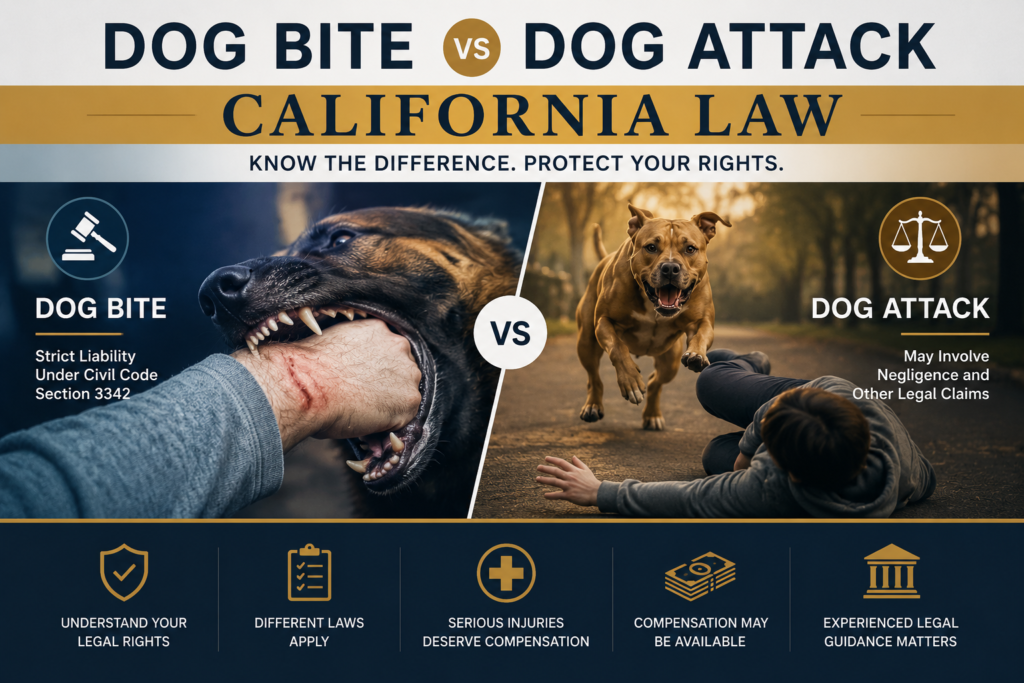
California’s primary dog bite statute, Civil Code Section 3342, imposes strict liability on dog owners for damages caused when their dog bites a person who is in a public place or lawfully on private property. The word “bites” is the operative term — and it is where the legal distinction between a bite case and a broader attack case begins.
Strict liability under Section 3342 applies specifically to the act of biting — a dog using its teeth to make contact with a person’s body. When the injury-causing incident involved teeth-to-skin contact, the analysis is relatively clean: the owner is automatically liable, no proof of negligence is required, and the victim’s legal path forward is clear. This is the framework covered in detail in our guide on what happens after a dog bite in California.
But dogs cause serious injuries in many ways that do not involve biting. When a 90-pound dog charges and knocks a person to the ground, breaking their wrist in the fall, no bite has occurred. When a dog lunges and its nails slash a child’s face, the injury came from claws, not teeth. When an owner’s dog pulls hard on a leash, causing the owner to fall into a passing pedestrian and injure them, no bite took place. When a runner trips and falls after a dog suddenly crosses their path, the teeth never made contact.
All of these are legitimate personal injury scenarios. Not all of them are covered by Civil Code Section 3342. But that does not mean the victims have no legal recourse — it means the applicable legal theory shifts from strict liability to negligence, and understanding that shift is what allows an experienced California dog attack injury lawyer to build a viable case even when no bite occurred.
When California Civil Code 3342 Applies
The strict liability rule under Section 3342 is triggered by three conditions: a dog bit a person, that person was in a public place or lawfully on private property, and the person suffered damages as a result. All three conditions must be present. When they are, the dog owner’s liability is automatic and absolute — no proof of negligence, no prior bite history, no knowledge of dangerousness required.
What Counts as a Bite Under California Law
California courts have interpreted “bite” to mean contact between the dog’s teeth and the victim’s body. The bite does not need to break skin to qualify. A dog that clamps down on clothing while in contact with a person’s arm and causes bruising or crush injury has technically bitten within the meaning of the statute. A dog that seizes a person’s hand without breaking the skin but causes a fracture from the pressure has bitten. The key element is teeth-to-body contact that causes injury.
What does not constitute a bite under the statute is contact caused exclusively by other parts of the animal — claws, body mass, the force of a collision — or injury caused by the victim’s reaction to a charging or pursuing dog rather than by direct physical contact. These scenarios require a different legal theory, and that theory is negligence.
Dog Attacks Without Bites — The Negligence Framework
When a dog causes serious injury without biting — or when the circumstances of the interaction do not clearly satisfy the elements of Section 3342 — California personal injury law provides a separate and fully operative path to compensation through general negligence doctrine.
Negligence requires proving four elements: the dog owner owed a duty of care to the injured person, the owner breached that duty, the breach caused the victim’s injury, and the victim suffered damages as a result. Unlike strict liability, negligence requires demonstrating that the owner’s conduct fell below a reasonable standard. But California’s negligence framework is broad and well-developed, and in the context of dog-related injuries, it supports claims in many situations where the bite statute technically does not apply.
Dog Knocks Someone Down
A dog that charges a person, jumps on them, or collides with them with sufficient force to cause a fall is one of the most common sources of serious non-bite dog injuries, particularly among elderly victims and children. A falling injury can produce broken bones, hip fractures, traumatic brain injuries from the fall impact, and spinal injuries — outcomes that can be as severe as or more severe than many bite injuries.
Under California negligence law, an owner who allows a large, powerful dog to run unsecured in an area where it is foreseeable that it will collide with people, or who fails to control a known jumper in the presence of vulnerable individuals, has breached a duty of reasonable care. Establishing negligence in these cases requires evidence of what the dog did, how the injury occurred, and why the owner’s failure to control the animal was unreasonable under the circumstances.
Claw and Scratch Injuries
Dog claws can produce significant lacerations, deep tissue injuries, and in attacks on the face, permanent scarring that rivals bite injuries in both medical severity and settlement value. Scratching injuries most commonly occur when a dog jumps aggressively at a victim and makes contact with its forepaws, or when a dog in a full attack mode uses its claws alongside biting behavior.
When scratching occurs in the context of an attack that also involves biting, the entire incident is typically addressed within the strict liability framework — the bite triggers Section 3342 and all associated injuries, including scratches, are compensable within that claim. When scratching occurs without any biting contact, negligence law applies and the analysis focuses on the owner’s failure to control an animal whose jumping and scratching behavior was known or foreseeable.
Leash-Related Injuries
Leash injuries represent a specific and underappreciated category of dog-related harm under California law. When a dog’s sudden lunging, pulling, or change of direction causes a person to fall, be dragged, or lose control in a way that produces injury, the victim may have a legitimate claim against the dog’s owner — even though the dog made no direct physical contact with the victim’s body. A retractable leash that wraps around a bystander’s leg and causes a laceration or bone fracture is a real and compensable event. A dog that pulls its owner into a third party, injuring that third party, creates a negligence claim against the owner for failing to control the animal.
These cases require careful documentation of exactly how the injury occurred, what the dog was doing at the moment of injury, and whether the owner’s control over the animal met a reasonable standard given the dog’s known size, strength, and behavior. Our severe dog attack injury attorneys handle leash-related cases regularly and understand the evidentiary approach these claims require.
Chase and Fall Injuries
When a person is injured not by direct dog contact but by the act of fleeing or reacting to a charging or pursuing dog, the legal path is through negligence rather than Section 3342. A runner who twists an ankle after sprinting to avoid a charging dog that never made contact. A cyclist who falls when swerving away from a dog that runs into the road. An elderly person who stumbles and falls when a dog rushes at them without warning. In each of these scenarios, the dog owner’s failure to control or contain their animal is the proximate cause of an injury that the victim’s reasonable self-protective instincts produced.
These cases can be more complex to prove than direct bite cases because the causal chain has an additional step — the victim’s reaction. But California law recognizes that a person’s instinctive response to an approaching dangerous animal is foreseeable, and that the owner whose animal created the dangerous situation bears responsibility for the injuries that foreseeable response produces.
The Practical Difference Between Strict Liability and Negligence Claims
For victims, the most important practical difference between a strict liability bite claim and a negligence-based dog attack claim is what must be proven and how. Under strict liability, proof of the bite and the victim’s lawful presence establishes liability — end of analysis. Under negligence, the victim must establish that the owner’s conduct was unreasonable and that this unreasonable conduct was the cause of the injury.
Negligence claims require more robust factual investigation. What were the circumstances of the attack? What did the owner know about the dog’s behavior? Had the dog jumped on people before? Had complaints been made? Was the animal properly contained? Were there leash laws in effect that the owner violated? In jurisdictions with leash ordinances — including most California municipalities and parks — a violation of those ordinances by the dog owner is evidence of negligence per se, meaning the ordinance violation itself establishes a breach of duty without requiring further proof of unreasonableness.
For premises liability dog attack cases — where the attack occurred at a rental property or business — negligence analysis becomes even more involved, requiring examination of what the property owner knew, when they knew it, and what reasonable steps they failed to take. These cases often produce access to commercial insurance coverage with higher limits than individual policies, making the additional factual development well worth pursuing.
Compensation Available in Dog Bite and Dog Attack Cases
The categories of compensation available in non-bite dog attack cases under California negligence law are substantively the same as those available in strict liability bite cases. Economic damages — medical expenses, lost wages, future care costs — and non-economic damages — pain and suffering, emotional distress, permanent scarring, loss of enjoyment of life — are all fully recoverable provided they are properly documented and causally connected to the attack.
What varies between bite and non-bite cases is not the categories of compensation but the evidentiary foundation required to claim them. In a bite case, the injury documentation supports the damages claim on a foundation of automatic liability. In a negligence attack case, the damages claim requires both injury documentation and a well-developed negligence narrative. This is not an insurmountable difference — it is a reason to involve an experienced attorney from the earliest stages of a non-bite dog attack case rather than attempting to navigate the claim independently.
As our guides on suing after a dog bite in California and settlement negotiation explain, the insurance mechanism that pays these claims is the same regardless of whether the legal theory is strict liability or negligence. The dog owner’s homeowner’s or renter’s insurance personal liability section responds to both types of claims, and the negotiations with that insurer follow the same general structure.
Evidence That Strengthens Both Types of Claims
Certain categories of evidence are essential regardless of whether the claim proceeds under strict liability or negligence theory. Medical records documenting injuries from the incident, photographs of injuries taken as soon after the event as possible, the official animal control report, witness statements from anyone who observed the attack or its aftermath, and documentation of the victim’s financial losses all apply equally to both claim types.
In negligence-based attack cases, additional evidence categories become particularly important: records of prior complaints about the dog’s behavior, animal control history for the specific animal, any evidence of previous jumping or charging incidents, local leash ordinance documentation, and evidence of the owner’s awareness of the dog’s tendencies. Where the attack occurred at a property with management, written communications between tenants and management about the animal are often the most valuable single piece of evidence in establishing the knowledge element of a premises liability claim.
For victims in communities throughout San Diego County — including Downtown San Diego, Chula Vista, and El Cajon — our attorneys handle both the evidence preservation and the legal theory development from the first day of representation.
Frequently Asked Questions — Dog Bite vs Dog Attack California Law
I was knocked down by a dog but not bitten. Do I have a legal claim in California?
Yes, potentially. While California Civil Code Section 3342 specifically covers bites, California negligence law applies to all types of dog-caused injuries. If the owner failed to reasonably control their animal and that failure caused your injury, you have a viable negligence claim. An attorney can evaluate the specific circumstances of your injury and advise on the strength and appropriate legal theory for your case. Call us for a free case evaluation.
What if the dog scratched me but did not bite?
Scratch injuries caused by dog claws without any accompanying bite are addressed under negligence theory rather than the strict liability statute. If the scratch caused significant injury — deep lacerations, scarring, infection — and resulted from the owner’s failure to control an animal whose jumping or aggressive behavior was known or foreseeable, you have grounds for a claim. Scratch injuries that occur alongside biting are typically incorporated into the overall strict liability bite claim.
Can I file a claim if a dog chased me and I injured myself while running away?
California negligence law recognizes that a person’s instinctive flight from a charging animal is foreseeable, and that an owner who fails to control an animal that causes that flight response can be held liable for resulting injuries. These cases require careful documentation of exactly what the dog was doing, where you were, and the causal chain between the dog’s behavior and your injury. Evidence and witness accounts gathered promptly after the incident are essential to these claims.
Is compensation for a non-bite dog attack covered by the owner’s homeowner’s insurance?
Generally yes. The personal liability section of a homeowner’s or renter’s insurance policy covers bodily injury claims arising from the policyholder’s negligent failure to control their pet — not just bite claims. Both strict liability bite claims and negligence-based attack claims typically proceed through the same insurance coverage mechanism. The insurer evaluates both types of claims against the same policy and using largely the same adjustment process.
Does California’s strict liability rule apply if a dog jumps on someone and injures them without biting?
Strict liability under Section 3342 applies specifically to bites. A jumping injury without a bite is addressed under negligence law, not strict liability. This means the victim must establish that the owner knew or should have known the dog had a tendency to jump in a dangerous way and failed to take reasonable precautions. Evidence of the dog’s prior jumping behavior, complaints to the owner, and the owner’s failure to restrain the animal in appropriate situations supports this negligence theory.
What if both a bite and a non-bite injury occurred in the same incident?
When the same attack involves both biting and other forms of injury — a dog bites and then knocks the victim down during the same encounter — the entire incident is typically addressed within the strict liability framework triggered by the bite. The non-bite injuries are compensable as part of the same claim because they arose from the same attack event. Separating the injuries into different legal theories is generally not necessary when both occurred in a single continuous incident.
Get a Free Evaluation of Your Dog Attack Case
Whether a dog bit you, knocked you down, scratched you, or caused you to fall during a chase, you may have a valid legal claim under California law. The specific legal theory — strict liability under Section 3342 or negligence — shapes how the claim is built and what evidence matters most, but both paths lead to the same outcome when properly pursued: full compensation for medical costs, lost wages, pain and suffering, and every other documented consequence of a dog owner’s failure to control their animal.
Our dog attack injury attorneys at dogbitelawyersandiego.com handle both bite and non-bite dog attack cases throughout San Diego County. A completely free case evaluation is available 24 hours a day — no upfront fees, no obligation, and no attorney costs unless we recover compensation for you.
Bitten by a Dog in California?
Get answers about your legal rights, potential compensation, and the next steps after a dog bite injury.